Reading time: 10 min read
Win the Answer: AEO Lessons from Sitecore Symposium 2026
Buyers are building their shortlists in a single AI prompt. Here’s what we learned at Sitecore Symposium about earning a spot in the answer, and what to do next.
Start typing to search...
Buyers are building their shortlists in a single AI prompt. Here’s what we learned at Sitecore Symposium about earning a spot in the answer, and what to do next.
One idea ran through every keynote, breakout session, and hallway conversation at Sitecore Symposium 2026 in Orlando last week: buyers now start in AI, and brands have to earn their place in the answer.
That focus started with Scrunch. In June, Sitecore acquired the AI search visibility and answer engine optimization (AEO) platform, used by more than 500 brands and agencies, in a deal Bloomberg valued at about $225 million. Scrunch shows brands how they appear in AI-generated answers across models, and it connects directly to Sitecore workflows so those insights become content updates inside SitecoreAI. At Symposium, that pairing framed the whole event: how to use SitecoreAI and Scrunch together to compete when buyers start in AI.
On day two, G2 Chief Innovation Officer Tim Sanders explained the mechanics behind it: how large language models (LLMs) like ChatGPT and Gemini decide which brands to recommend, and why most marketing teams are measuring the wrong thing.
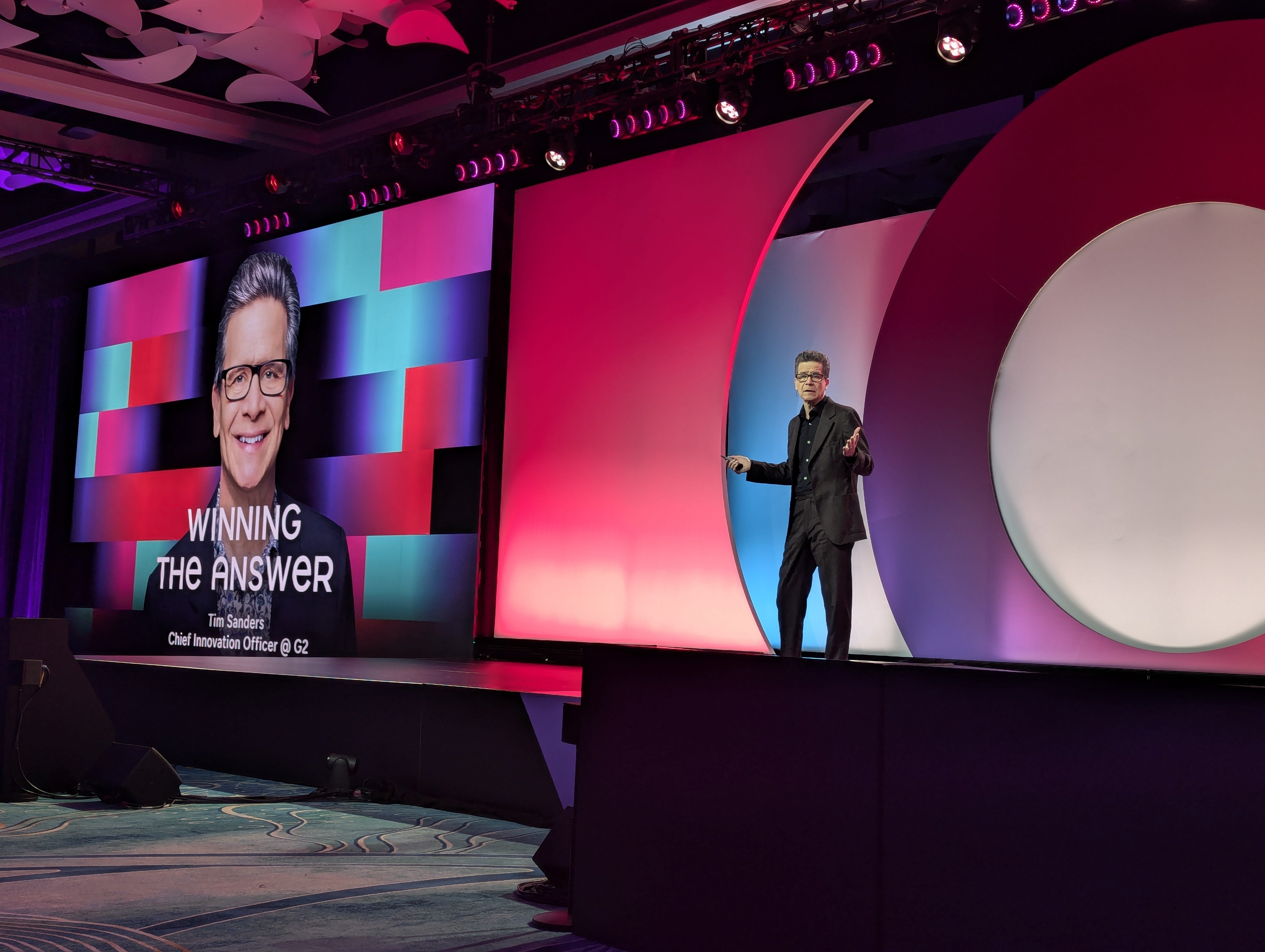
G2's Tim Sanders on stage for the day two keynote, "Winning the Answer."
Here's what we took away, where we see AI heading, and what it means for your team.
G2's research shows how fast the starting point has shifted:
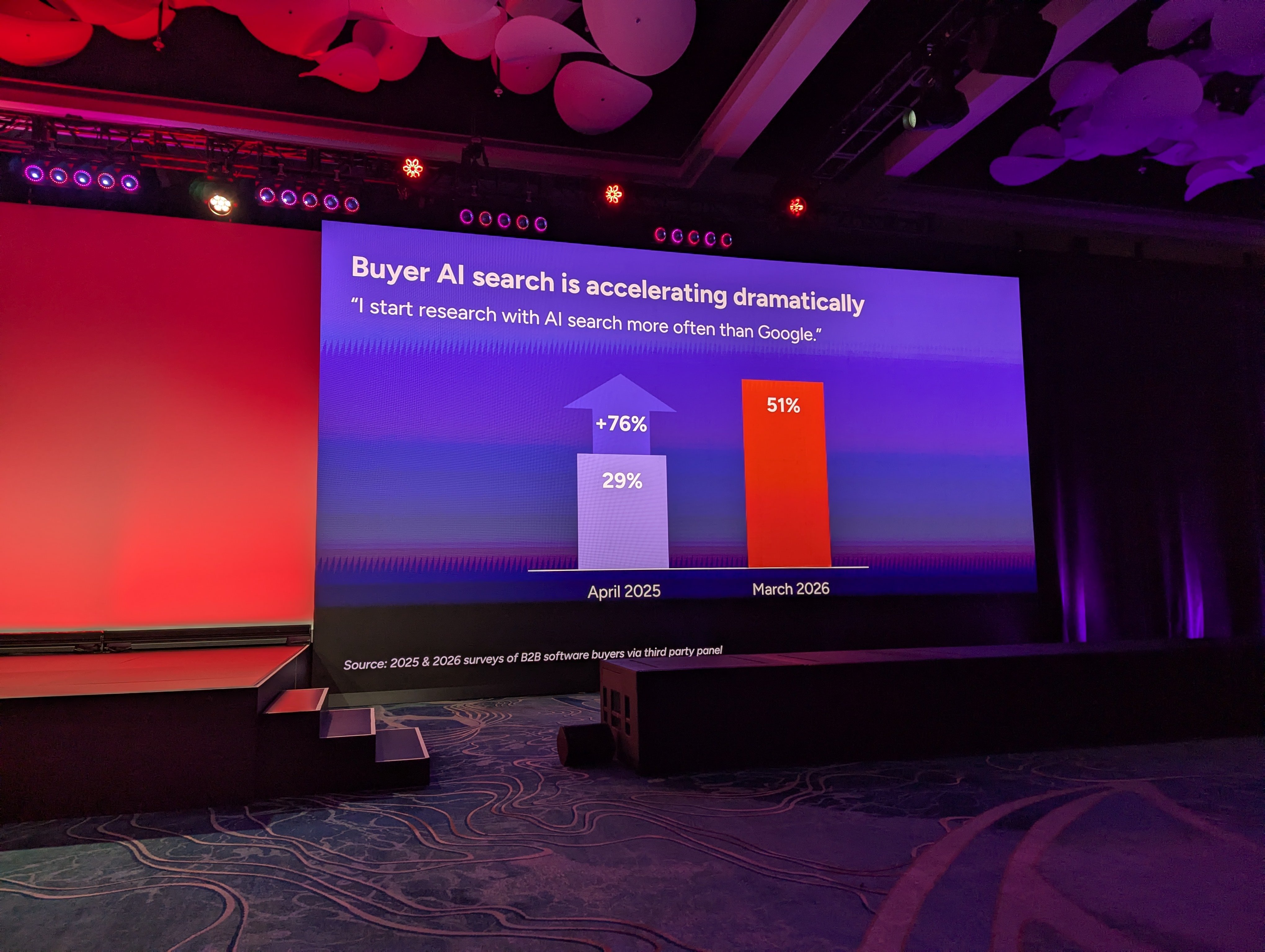
Half of B2B software buyers now start in AI search instead of Google. Source: G2 2025 and 2026 buyer surveys.
Buyers are also building that shortlist in one prompt. Research that used to take 6 to 15 working hours of Googling, analyst reports and spreadsheets now happens in a single exchange, and the model typically returns three options with caveats.
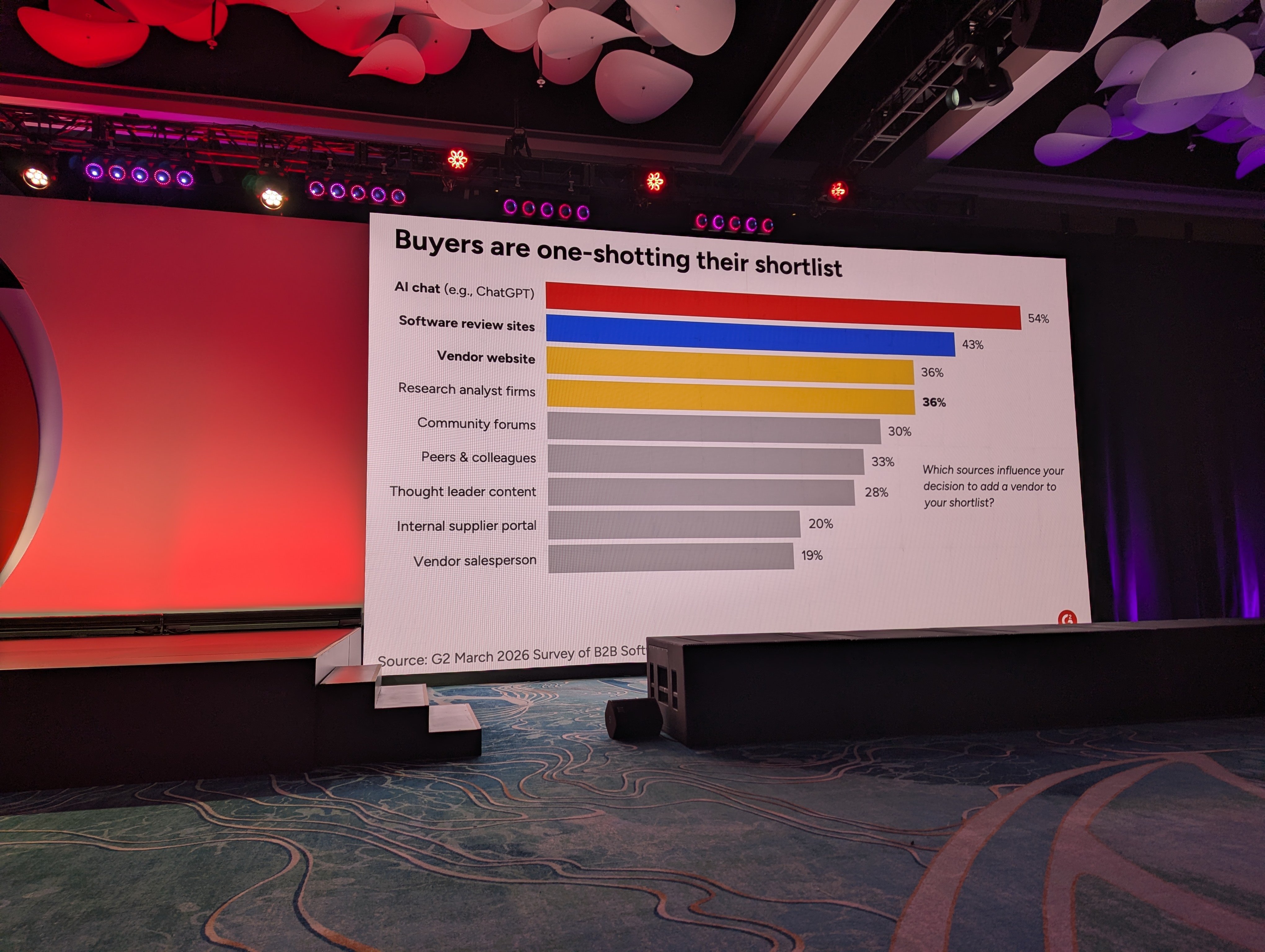
AI chat now outranks review sites, vendor websites and analysts in shaping the shortlist. Source: G2 March 2026 survey.
Tim's framing for the year ahead: win the answer. Be one of the three.
Most answer engine optimization (AEO) and generative engine optimization (GEO) reporting tracks mentions and citations. Tim called citations "the eyeballs of 2026," the modern version of counting website hits.
The click-through gap makes the case:
| AI search outcome | Approx. click-through rate |
|---|---|
| Citation (link under the answer) | ~0.1% |
| Branded citation | ~0.33% to 0.5% |
| Recommended solution | ~7% (roughly 70x a citation) |
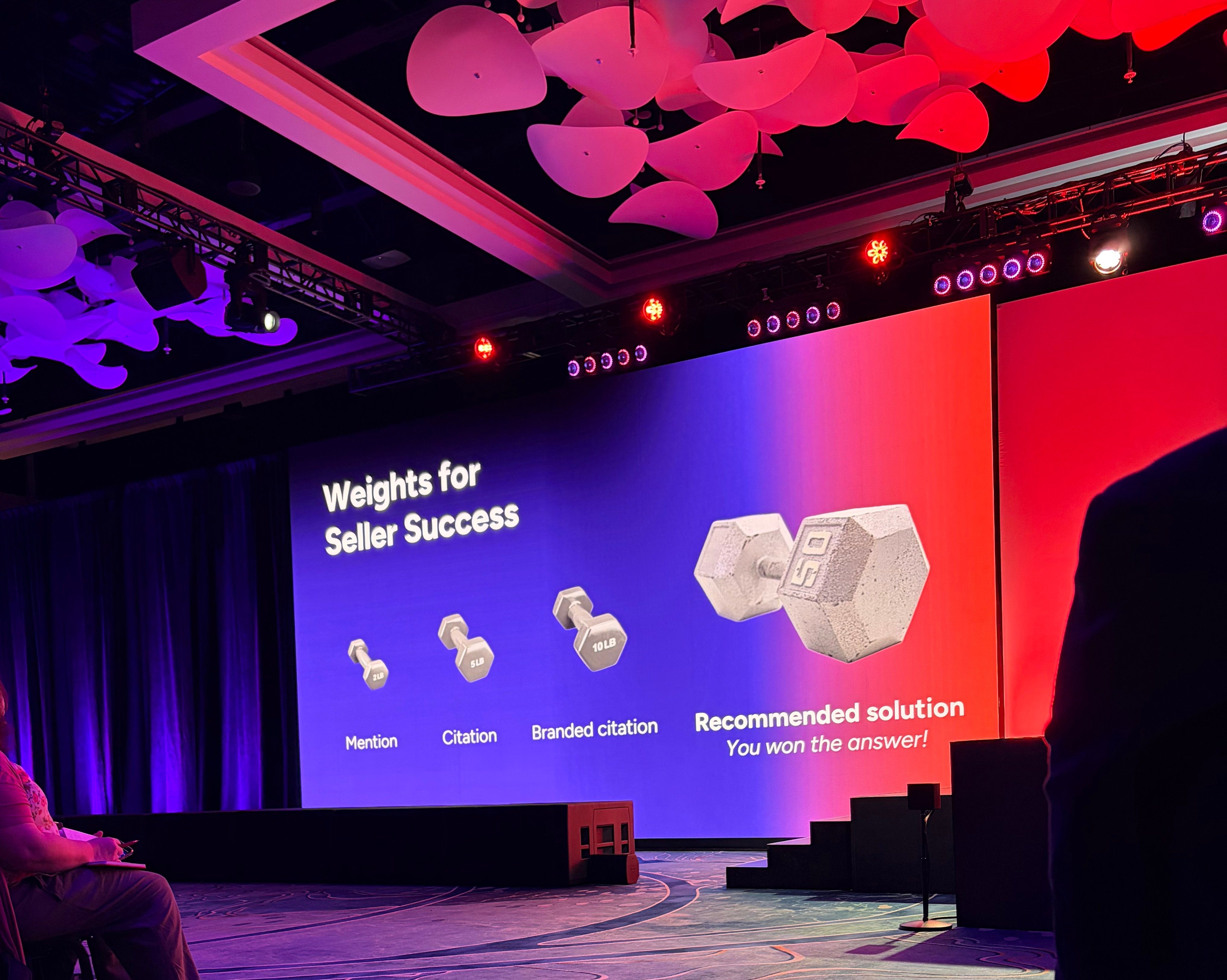
Every outcome carries a different weight. A recommendation is the one that moves pipeline.
One September study found brands can be cited by AI and still left off the recommendation list 60% of the time.
The reason: agents separate the publishing entity from the product entity. Humans reward helpful content with product consideration. Models are tuned to avoid regrettable recommendations, so great thought leadership earns you a citation and nothing more. As Tim put it, "agents are ungrateful."
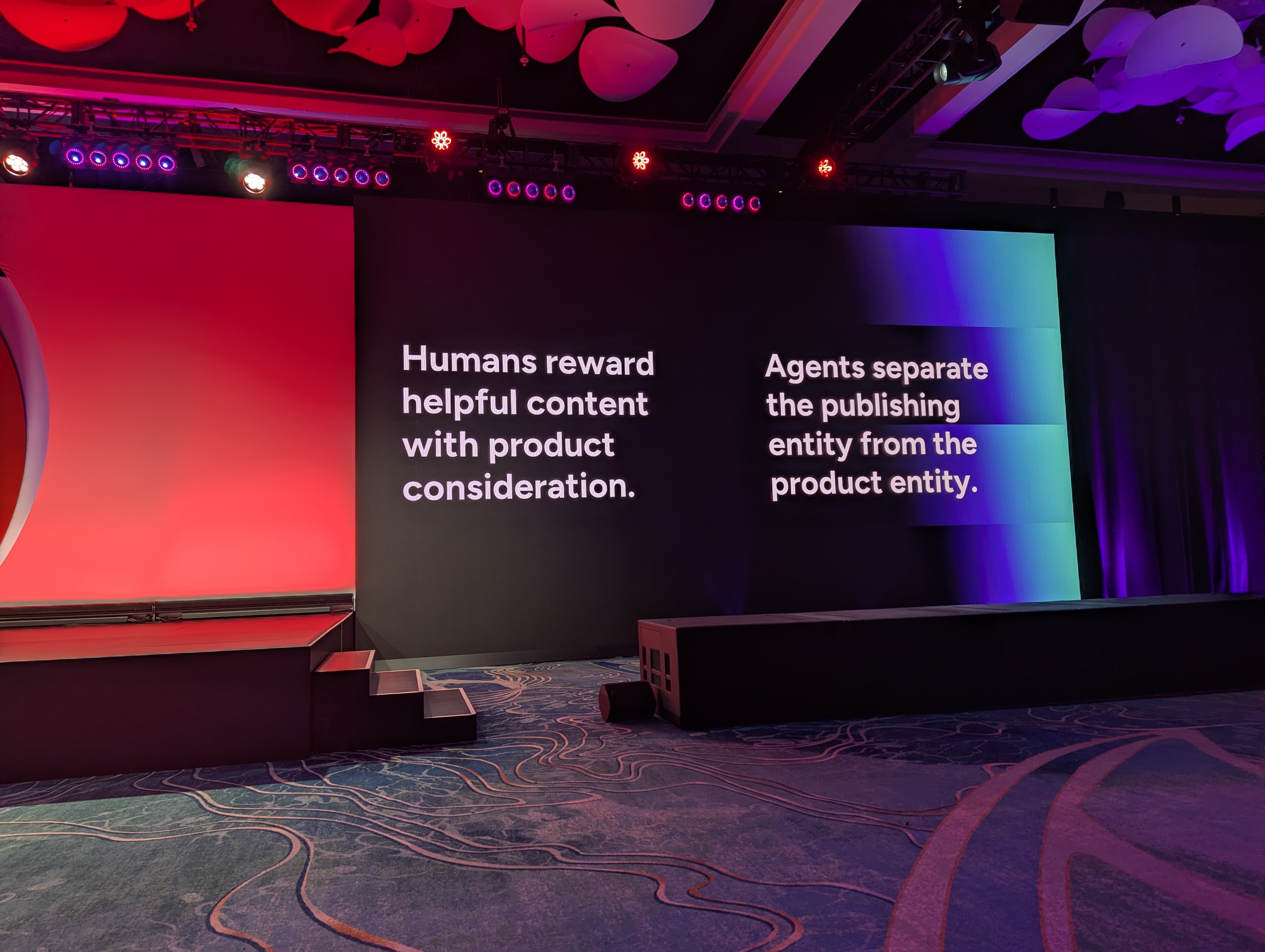
Content marketing earned consideration with people. Agents judge the product on its own evidence.
Academic research points to the same three steps every time:
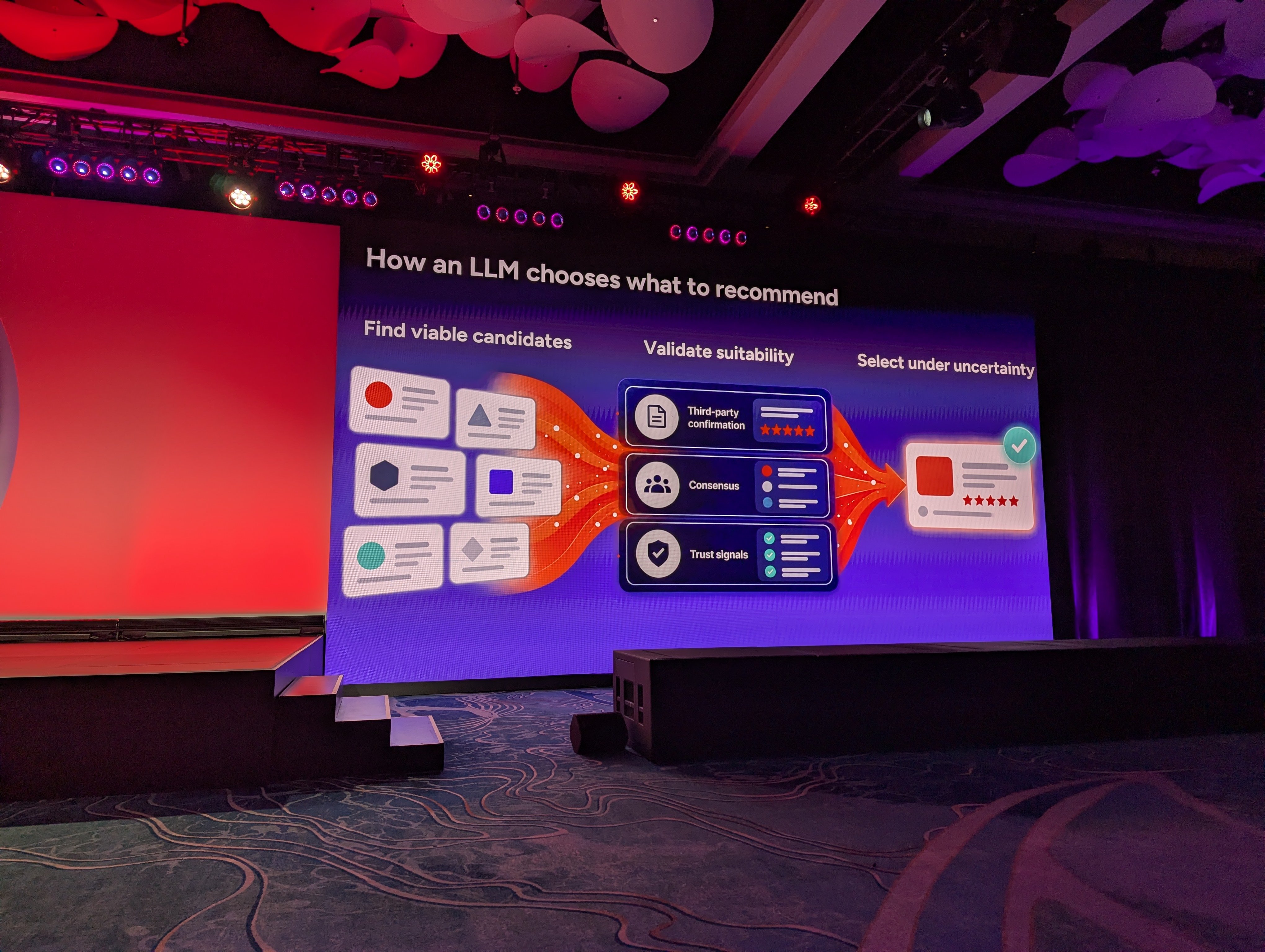
Candidacy, validation, selection: the three steps behind every AI recommendation.
What drives that confidence? FirstPageSage's March 2026 breakdown of ChatGPT's recommendation weighting:
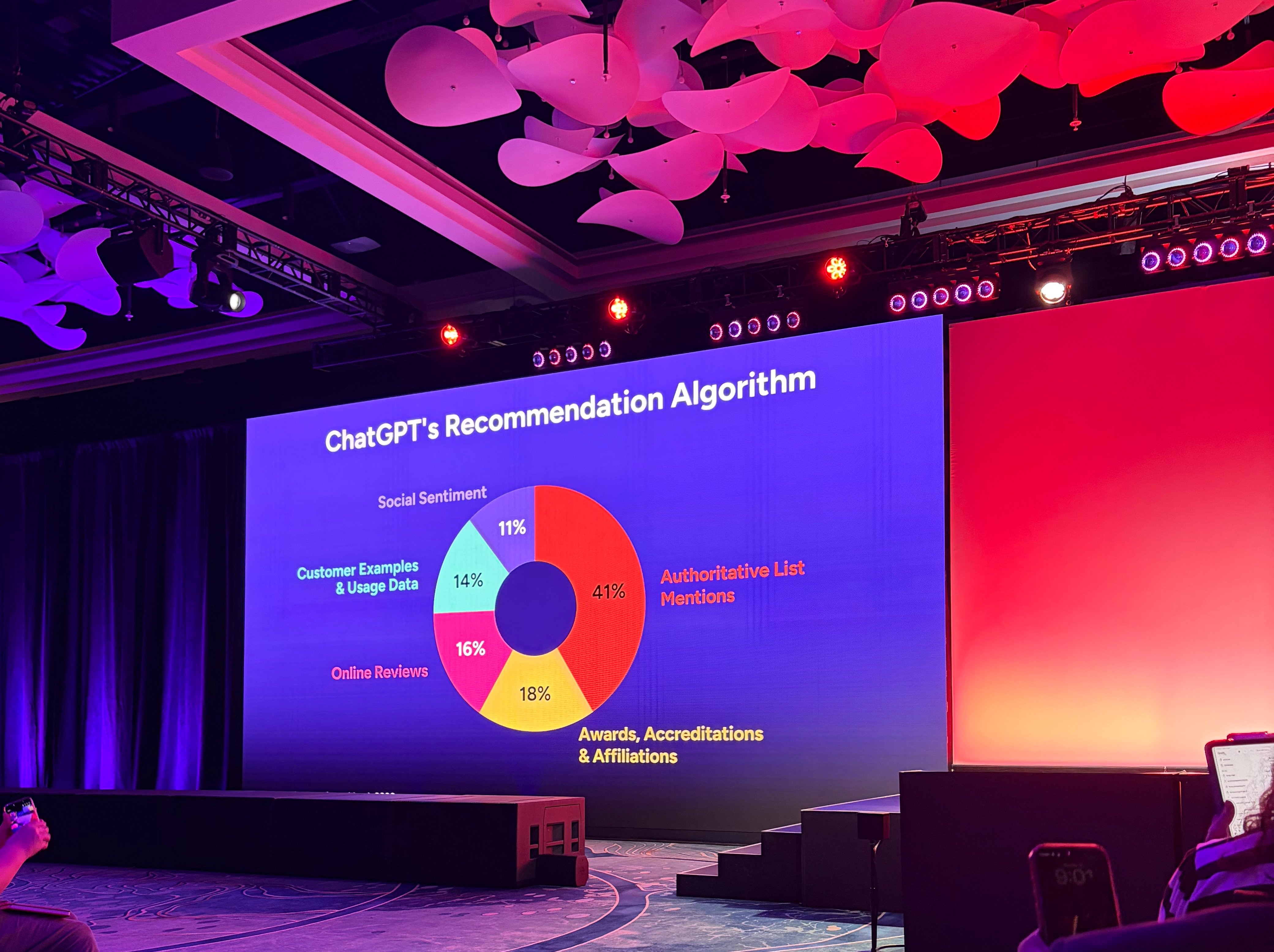
Third-party signals drive the recommendation. Source: FirstPageSage, March 2026.
Two details from the session stood out. A security vendor knew it won 80% of deals when prospects believed its 25ms latency claim, yet its reviews and testimonials only said "easy to use." Generic praise corroborates nothing. And hiding pricing or contract terms behind a sales call signals manipulation risk to the model, which can drop you from consideration entirely.
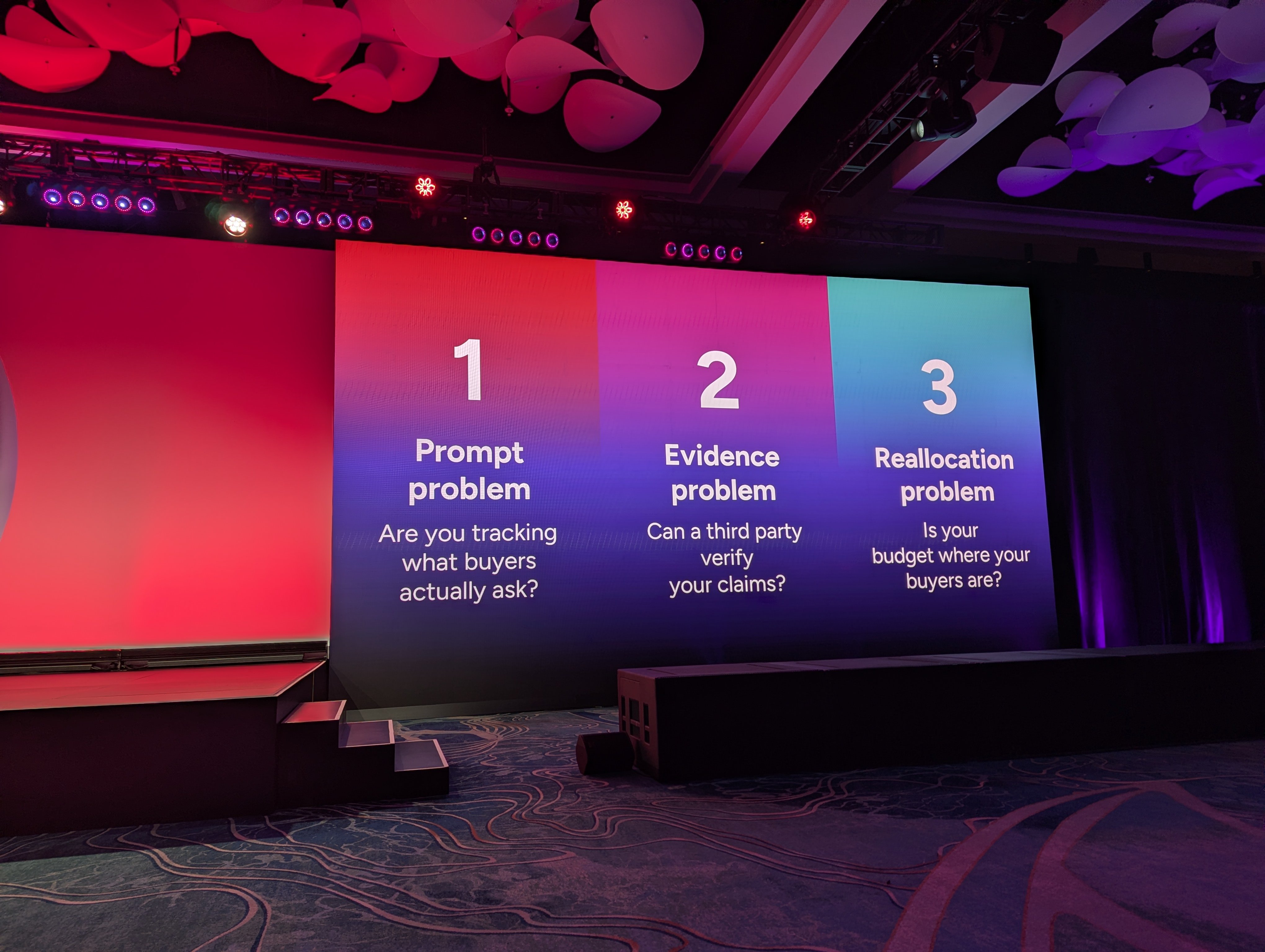
Are you tracking what buyers actually ask? Can a third party verify your claims? Is your budget where your buyers are?
Most prompt panels are built from keywords and product marketing language, then converted into guessed questions. Real prompts look nothing like that.
A real hospital buyer didn't search "best CRM for hospitals." They asked for an affordable solution covering patient scheduling, messaging and reimbursement processing, that works on mobile, from vendors that don't require a one-year contract. Every one of those requirements has to be answered by your own documentation.
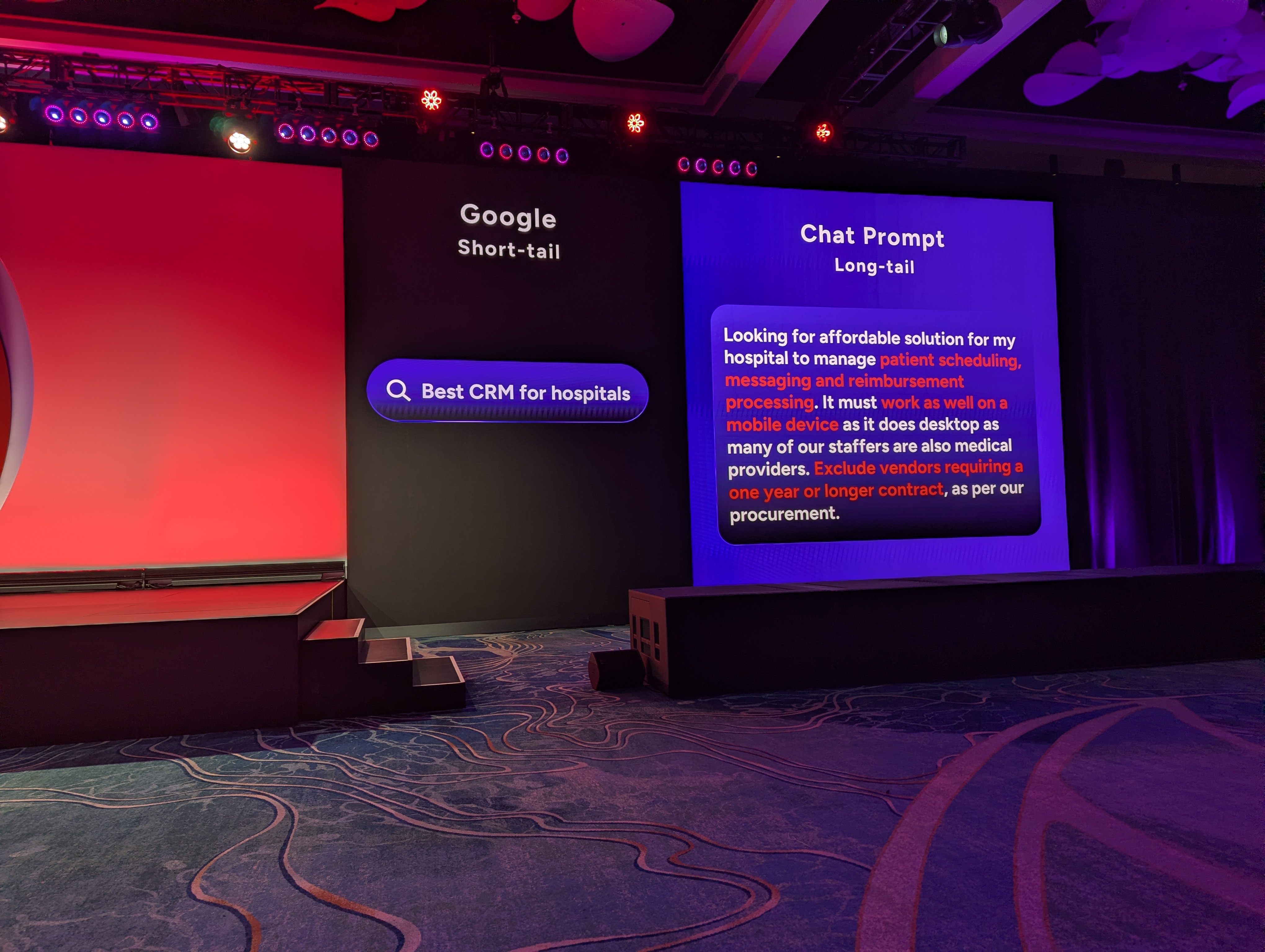
Short-tail search versus a real long-tail prompt. Every highlighted requirement has to be answered by your own content.
The agent is loyal to the buyer's language. Teaching the market a new category name before they're in your funnel no longer works. Tim's advice: build synthetic personas around your ICP (job to be done, constraints, vocabulary, success metrics, decision criteria) and sharpen your prompt panels with real customer language from reviews, sales call transcripts, RFPs and direct prompt capture by your BDRs. CMOs told him 100 real prompts will change your site build, content strategy and evidence strategy.
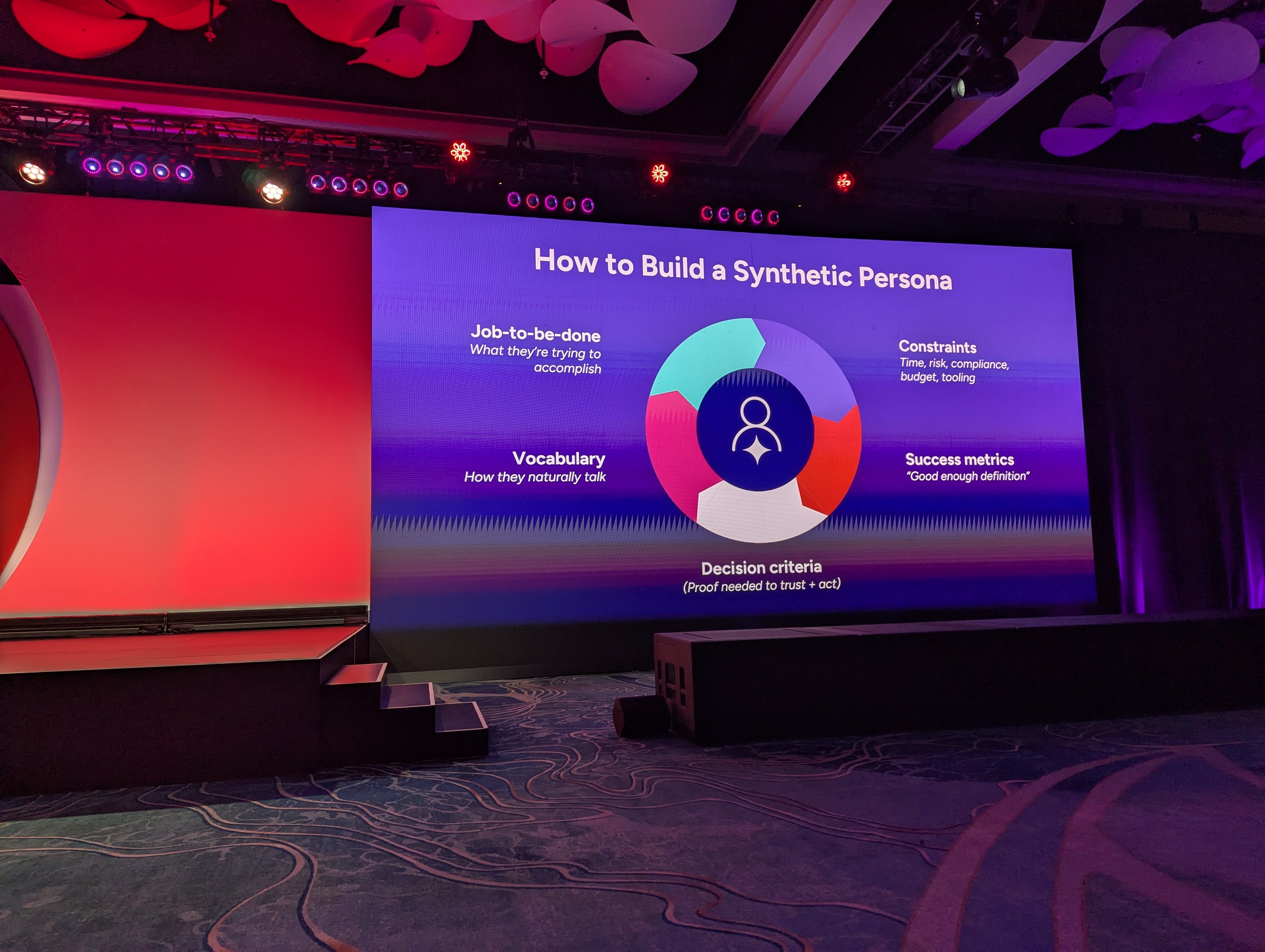
The five components of a synthetic persona built around your ICP.
If pipeline and conversions are down, you don't have an AI visibility problem. You have an evidence problem.
Winning the answer means getting third parties to verify the specific claims that win you deals: reviews, analyst coverage, awards, customer stories and authoritative lists that say exactly what your website says.
For every $1 B2B companies spend on AEO in 2026, they spend $40 on SEO. That's 2.5% of search budget going to where half of buyers now start.
G2's recommended split for AEO dollars:
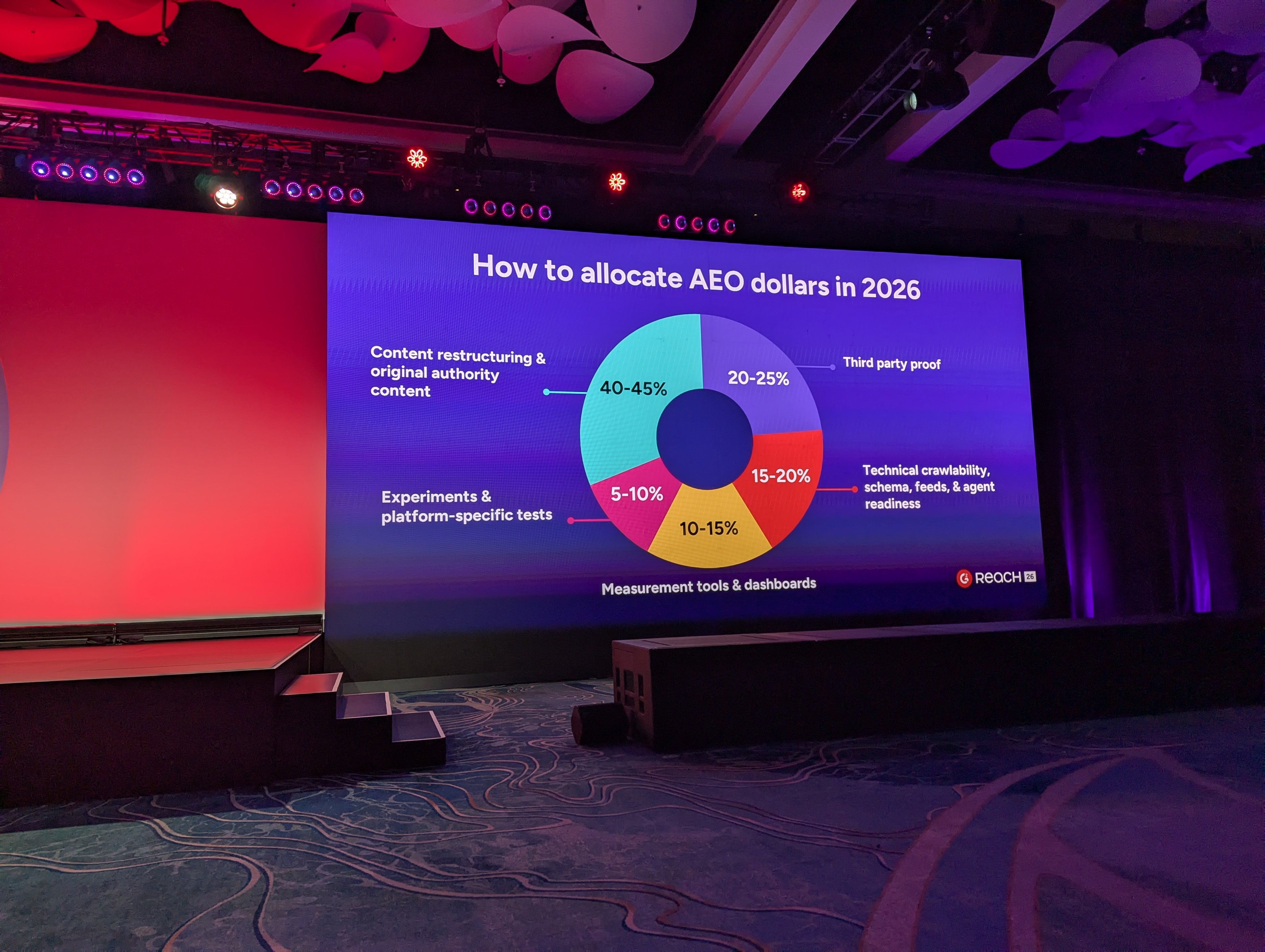
G2's recommended split for AEO investment in 2026.
SEO still matters. Website authority accounts for an estimated 38% of Gemini's algorithm. The logic underneath has changed, though, because the buyer doing the research is now an agent.
The upside: agentic shopping sits on top of these same models. The work you do now on prompts, evidence and structure carries forward as agents start purchasing on buyers' behalf.
Symposium confirmed what we've been building toward at Fishtank.
Discovery runs on agents, so execution has to as well. The workload Tim described is significant: building personas, mining real buyer language, restructuring content, maintaining schema and feeds, gathering evidence and measuring recommendation share. It changes as fast as the models do. Teams can't keep up with that manually.
The value lives between systems. Your buyer language sits in your CRM and call transcripts. Your proof sits in reviews and customer data. Your AI search performance sits in Scrunch. The fix gets published in SitecoreAI. AI bolted onto any single platform can't connect them, and that coordination is where marketing teams lose most of their time.
That's what FishtankOS is built for. FishtankOS is the agentic orchestration layer that connects SitecoreAI to the tools your team already runs on, including Teams, Salesforce, Jira and analytics. It reads intent, routes the work to the system that owns it and delivers output where your team already works. Nothing goes live without human sign-off.
Applied to AI search, that means a marketer can ask in plain language to surface high-intent signals from Salesforce, consolidate pages that compete with each other, rebuild a product page around real buyer requirements with the right metadata, or generate a recurring performance report. The expertise required to operate each system is handled by the intelligence layer.
The brands that win the answer will pair the right insight with the capacity to act on it continuously. When execution stops being the constraint, the bottleneck becomes imagination.
Where you need to go: from optimizing for visibility to earning recommendations, backed by first-party content agents can verify and third-party proof that corroborates it.
What to do now:
Conversations to have internally:
Tim made the point that AI search is reshaping buying faster than the internet did. He also offered some good news: agents run on the same models that make recommendations today. The prompts you capture, the evidence you build and the content you restructure this year will keep paying off as agents move from recommending products to buying them.
The brands that start now will be the ones buyers' agents trust first. That's the work we're doing with SitecoreAI customers at Fishtank: finding where you stand in AI answers, closing the gaps in your content and proof, and giving your team the capacity to keep up with FishtankOS.
Whether you're evaluating Scrunch, planning your SitecoreAI roadmap or mapping your 2027 priorities, we'd love to help you figure out where to start. Reach out to the Fishtank team and let's talk about how to win the answer.
Until then, happy optimizing!