Reading time: 8 min read
AI adoption vs. AI impact: Why most organizations fail to scale AI
Most organizations are investing in AI. Few are redesigning themselves to capture its value.
Start typing to search...
Most organizations are investing in AI. Few are redesigning themselves to capture its value.
AI adoption is no longer the problem. Turning AI into real business value is.
Research from McKinsey & Company shows that 88% of organizations now use AI in at least one business function. Yet only 39% report any measurable impact on EBIT, and most of those gains account for less than 5% of enterprise earnings.
This gap defines the current AI moment. Organizations are investing heavily in AI, but few are seeing it translate into meaningful, enterprise-wide results. For business leaders, the question is no longer whether to adopt AI. It is why so many AI initiatives stall before they deliver lasting value.
This article breaks down what the data reveals about that gap, what distinguishes organizations that are seeing real returns, and what leaders need to change, not just in technology, but in how their organizations are designed, to make AI work at scale.
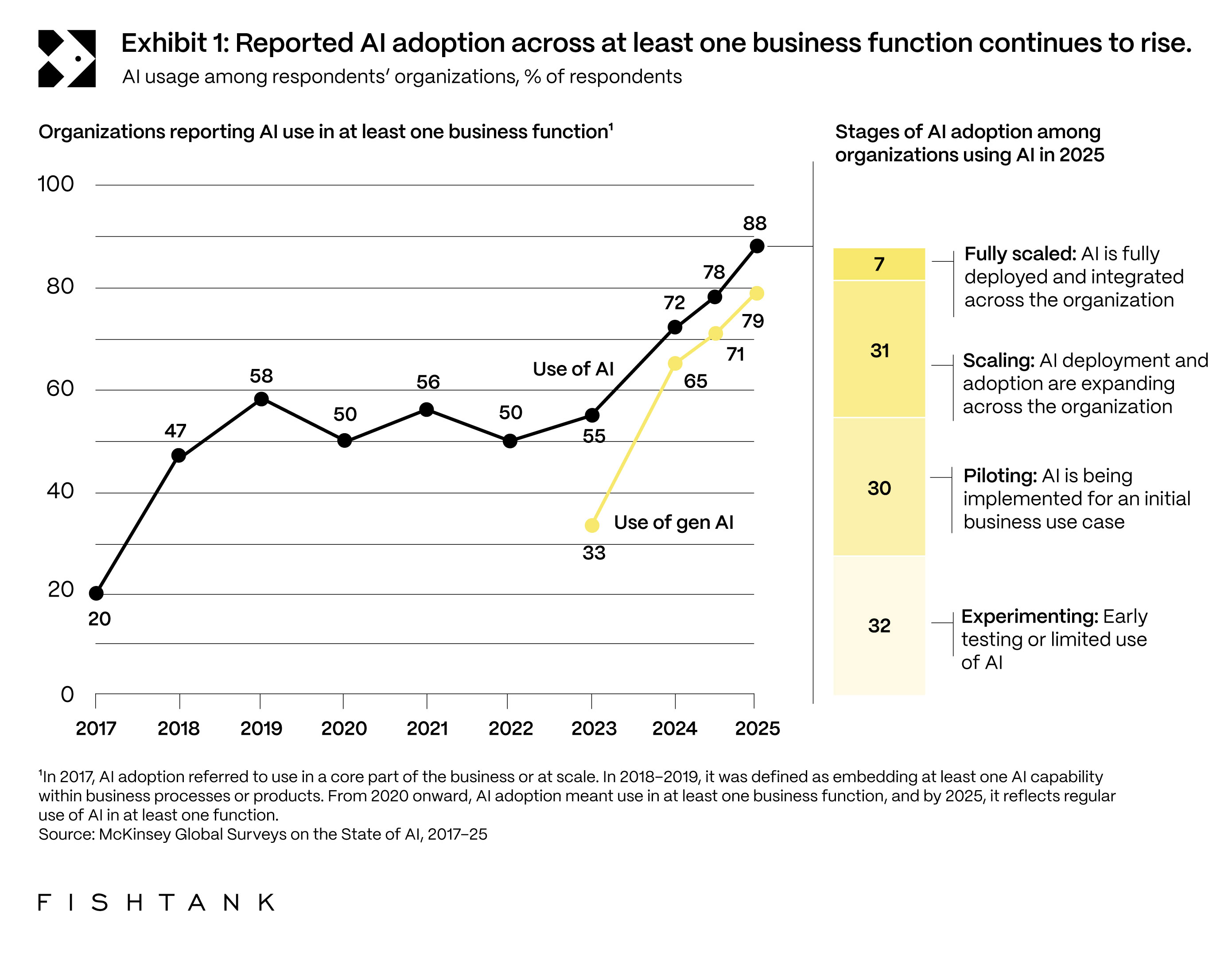
Nearly two-thirds of organizations remain stuck in experimentation or early piloting, while only about one-third are actively scaling AI across the enterprise. This gap has persisted even as overall AI adoption has increased.
On the surface, this can look like progress. More teams are running pilots. More use cases are being tested. But most organizations are moving sideways across experiments rather than forward toward enterprise impact.
Pilots answer a narrow question: Can this model work?
They do not address the questions that determine value:
Because pilots are typically isolated within individual teams, they rarely change decision rights, incentives, or operating rhythms. The result is localized optimization rather than systemic improvement.
When AI is layered onto legacy workflows, decisions are made the same way, bottlenecks shift rather than disappear, accountability remains unclear, and enterprise metrics stay flat. That is why many organizations report use-case-level efficiency gains but struggle to show meaningful EBIT impact.
The inflection point is simple: AI does not compound through more pilots. It compounds when organizations redesign how work happens.
This is not a technology problem. It is an operating-model one.
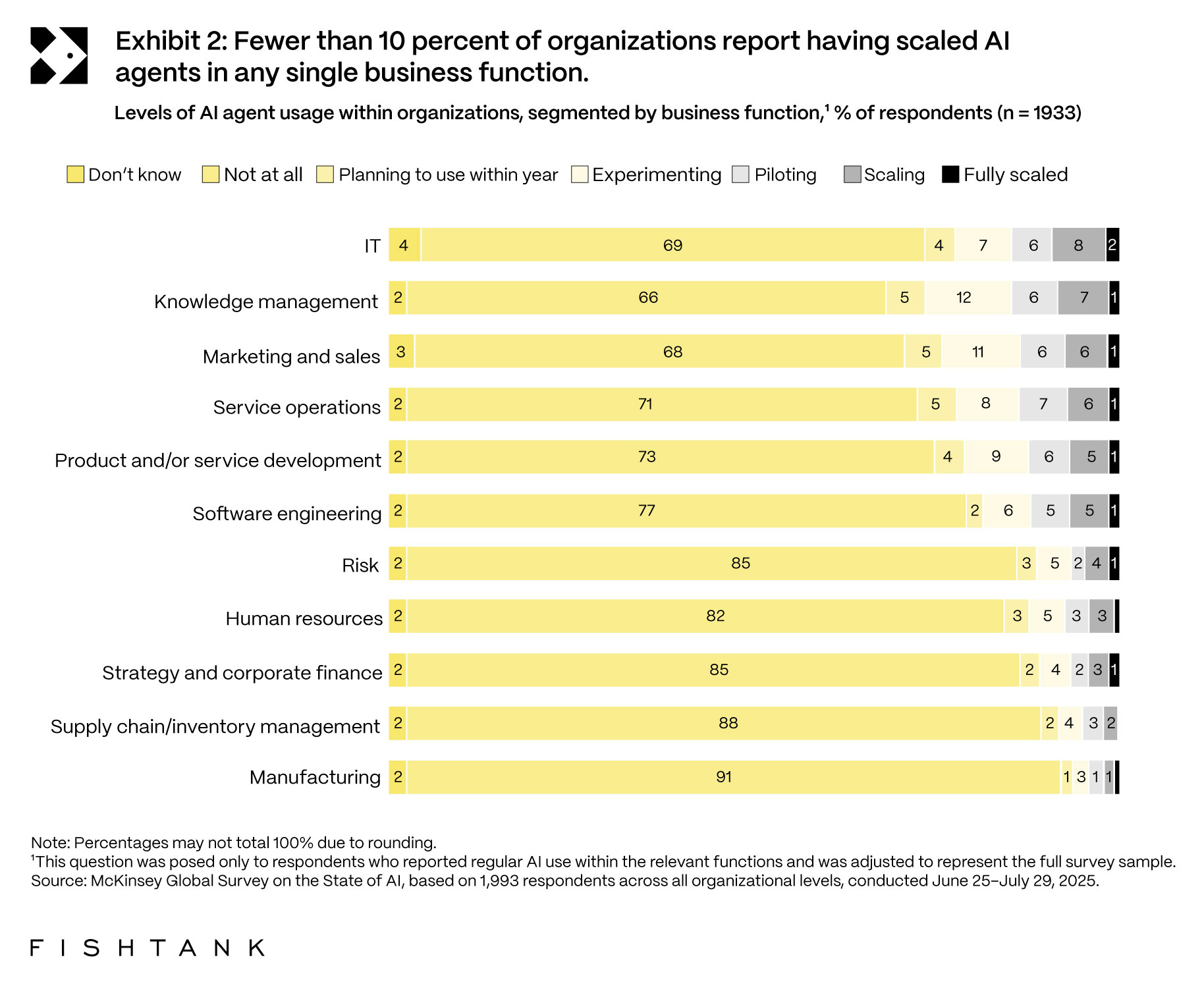
AI agents promise autonomous, multi-step execution, and interest is high. While 62% of organizations report experimenting with AI agents, only 23% have begun scaling an agentic system anywhere in the enterprise, and typically in just one or two functions. As the data shows, no individual business function has more than 10% of organizations reporting agent use at scale.
Across functions, the pattern is consistent. The largest share of activity remains in experimentation or early piloting, with scaling and fully scaled use representing only a small fraction in every area. Adoption is most advanced in IT, knowledge management, and software engineering, where work is already structured, repeatable, and easier to govern. In functions with greater cross-team dependency or variability, agent adoption drops off sharply.
The implication for leaders is clear. AI agents do not overcome weak operating models. They reveal them. Where workflows, ownership, and escalation paths are well defined, agents can meaningfully accelerate execution. Where those foundations are missing, agent initiatives stall regardless of technical capability.
This is why agentic AI should be viewed less as a shortcut to autonomy and more as a stress test of organizational readiness.
Despite limited enterprise-wide impact, AI is already delivering measurable value in specific parts of the organization. The pattern of where that value shows up is consistent, and it offers an important signal for leaders evaluating where to focus next.
Cost reductions are most commonly reported in:
These functions share a common trait: work is technical, repeatable, and closely tied to execution. In these environments, AI is well suited to automate tasks, reduce rework, improve throughput, and shorten cycle times. The result is visible efficiency gains at the team or function level, even when broader enterprise impact remains limited.
Revenue increases, however, follow a different pattern. They appear most often in:
In these areas, AI is not just improving efficiency. It is shaping decisions. Whether it is influencing customer targeting, informing product direction, or supporting strategic trade-offs, AI is embedded into moments that directly affect what the business does next.
This distinction matters. Cost-focused use cases tend to optimize existing work. Revenue-focused use cases change outcomes.
The organizations seeing revenue impact are using AI inside decision-making and execution loops, not as a retrospective assistant or analytical add-on. AI informs choices in real time, influences priorities, and alters the path forward. That is why revenue impact remains harder to achieve but more meaningful when it appears.
For leaders, the takeaway is not that cost-focused AI is unimportant. It is that enterprise value does not emerge evenly across all use cases. AI delivers its greatest returns when it is embedded where decisions are made and actions are taken, not just where work is processed.
Only 6% of organizations qualify as \"AI high performers\", meaning they attribute more than 5% of EBIT and significant enterprise value to AI. This is a small group, but the contrast between these organizations and everyone else is sharp.
What separates them is not access to better models or more advanced tools. It is how they think about AI's role in the business.
High performers are 3.6 times more likely to pursue transformative business change, rather than limiting AI initiatives to incremental efficiency gains. While most organizations focus on cost reduction, high performers consistently pair efficiency goals with explicit growth and innovation ambitions.
Ambition shapes behavior. Organizations that frame AI as optimization deploy it cautiously and locally. Organizations that frame AI as transformation invest differently, organize differently, and accept short-term complexity in exchange for long-term advantage.
AI becomes strategic when leaders stop asking how it can make today's processes cheaper and start asking how it can enable the business to operate differently.
Among all factors analyzed in the research, fundamental workflow redesign shows one of the strongest correlations with AI value creation.
AI high performers are nearly three times more likely to redesign workflows as part of their AI initiatives, including changes to:
Without redesign, AI accelerates tasks but leaves the system unchanged. Bottlenecks shift. Accountability fragments. Enterprise metrics remain flat.
This is where platform-level approaches become critical.
Rather than treating AI as a separate capability, platforms such as SitecoreAI embed intelligence directly into core digital workflows. Content creation, personalization, search, and experience optimization are designed with AI operating inside the execution layer, where decisions already happen at scale.
AI that operates inside execution systems compounds. AI that sits outside them remains episodic.
As AI use expands, so does exposure to risk. 51% of organizations report experiencing at least one negative consequence from AI use, most commonly due to inaccuracy, followed by cybersecurity and regulatory compliance issues.
AI high performers report more incidents, not fewer, because they deploy AI in higher-stakes, mission-critical workflows where errors are visible and consequential.
What differentiates them is governance.
High performers are significantly more likely to have defined human-in-the-loop processes, specifying when AI outputs require validation, escalation, or override. These controls do not slow progress. They enable trust, accountability, and regulatory confidence at scale.
Human oversight is not a temporary safety measure. It is a structural requirement for enterprise AI.
To date, AI has had a more nuanced impact on the workforce than many narratives suggest. In the past year, most organizations reported little to no net change in headcount as a result of AI adoption.
Looking ahead, expectations are shifting. 32% expect enterprise-wide workforce reductions of at least 3%, while 13% expect growth. The divergence reflects uncertainty, not consensus.
What is clear is that skill composition is changing faster than total headcount. Organizations are hiring for data engineers, machine-learning engineers, and AI product leaders, even as automation reshapes other roles.
AI changes what work looks like before it changes how many people do it.
The findings point to five clear imperatives:
Organizations that align AI with their operating model consistently outperform those that treat it as a collection of tools.
The AI paradox outlined at the start of this article is no longer theoretical. Most organizations have adopted AI, but few have redesigned themselves to capture its value. The evidence is clear: enterprise impact does not come from more tools or more pilots. It comes from embedding AI into the workflows, decisions, and systems where work actually happens.
This is where the conversation moves from strategy to execution. Platforms such as SitecoreAI illustrate what it looks like to operationalize AI inside the digital experience layer, not as an add-on, but as part of the core operating model.
Rather than treating AI as a separate capability, SitecoreAI embeds intelligence directly into content creation, personalization, search, and experience optimization. These are the same execution and decision-making loops where value is already created at scale. As a result, AI is not applied after the fact. It continuously shapes outcomes as work is being done.
For leaders navigating how AI will shape their organizations, the path forward is not about adopting more AI. It is about becoming structurally ready for it. Our Intro to SitecoreAI blog explores this next phase in more detail, focusing on how organizations can move from AI activity to AI advantage by designing digital experience platforms that are built to absorb intelligence, not just deploy it.
Until next time, happy automating!
We appreciate you contacting us, and a member of our team will be in touch shortly to address your inquiry.