Reading time: 15 min read
Agentic Studio: Inside SitecoreAI's engine for agentic workflows
How agents, flows, and governance turn AI into real, scalable work across content, campaigns, and experiences in SitecoreAI's Agentic Studio.
Start typing to search...
How agents, flows, and governance turn AI into real, scalable work across content, campaigns, and experiences in SitecoreAI's Agentic Studio.
SitecoreAI represents a shift in how digital experience platforms apply AI. Not as isolated features or assistive overlays, but as a system designed to reason, act, and execute across content, data, and experience layers.
Agentic Studio sits at the center of that shift.
If you're still getting familiar with SitecoreAI as a platform, our Intro to SitecoreAI article covers the broader architectural direction and foundational layers this capability builds on. This post intentionally narrows the focus.
Rather than restating the full SitecoreAI vision, this article dives into Agentic Studio itself: what it enables, how it fits into the SitecoreAI ecosystem, and why it is the piece that turns AI from an available capability into something teams can actually operationalize at scale.
Agentic Studio is SitecoreAI's AI-first workspace for designing, deploying, and managing agents and agent-driven workflows.
It is not:
Agentic Studio exists to support long-running, outcome-oriented work that spans multiple systems, steps, and decisions. It introduces a governed environment where AI agents can reason, act, collaborate with humans, and operate directly inside the Sitecore platform.
In practical terms, Agentic Studio is where AI stops suggesting and starts executing.
Traditional AI tooling breaks down as soon as work stops being simple. Prompt-based interactions work for single-step tasks, but they fail when work spans multiple systems, requires coordination, or unfolds over time. Real business processes rarely fit into a single interaction window.
Agentic Studio exists because AI has outgrown that interaction model.
Modern models are now capable of reasoning through longer, more complex sequences of work. What has been missing is the infrastructure to support that capability in real operating environments. Agentic Studio provides that missing layer: orchestration, state management, visibility, and governance around how AI operates over time.
Instead of forcing everything into a single response, Agentic Studio assumes work may take minutes or hours, may require human review at specific checkpoints, and must operate within enterprise controls. It is designed for outcomes, not interactions.
This is the problem space the rest of the article explores. Everything that follows builds on this premise: Agentic Studio is not about making AI smarter in isolation, but about making AI usable, accountable, and scalable inside real systems.
Agentic Studio is not a standalone product or an isolated UI. It sits on top of the SitecoreAI foundation and exists specifically to orchestrate the capabilities that already live within the platform. Its role is to turn intelligence, data, and APIs into coordinated, long-running work.
At a platform level, Agentic Studio draws power from three core layers.
The AI Foundation provides the shared intelligence layer that all agentic work depends on. This includes centralized AI services, a growing set of pre-approved AI skills, and the governance mechanisms required to operate AI safely in production environments.
From an operational perspective, this layer is what ensures consistency and control. Agents do not bring their own ad hoc models or unmanaged logic. They rely on standardized skills, shared monitoring, and built-in compliance so that AI behavior remains observable, auditable, and aligned with enterprise policies as usage scales.
Agentic workflows are only as valuable as the data they can reason over. SitecoreAI's unified data and content layer gives agents direct access to the systems where real work already lives.
This includes CMS content and structure, customer profiles, events, and affinities, as well as assets, briefs, campaigns, and performance data. Because this information is unified rather than fragmented, agents can operate with awareness of both what exists and what is happening, instead of relying on static inputs or manually assembled context.
The practical outcome is that agents can generate, evaluate, adapt, and optimize experiences using live content and real behavioral data, not disconnected snapshots.
The Agent API and Model Context Protocol form the execution backbone of Agentic Studio. MCP provides LLM-friendly, programmatic access to Sitecore capabilities, allowing agents to interact with the platform in a structured, governed way.
Through this layer, agents can create, modify, publish, personalize, and analyze experiences directly. They are not limited to generating recommendations or drafts. They can take action inside SitecoreAI while respecting permissions, workflows, and system constraints. This is what enables agents to participate in real operational processes rather than acting as advisory tools.
Agentic Studio sits above these layers as the orchestration layer. It is where intelligence, data, and APIs are coordinated into workflows that can reason over time, make decisions, pause for human input, and complete work end to end.
Instead of forcing teams to stitch capabilities together manually, Agentic Studio provides a structured environment where AI-led workflows are context-aware, grounded in real data, and executed within defined guardrails. This is the point where SitecoreAI moves from enabling AI to operationalizing it across the digital experience lifecycle.
There are two ways to access the Agentic studio within SitecoreAI.
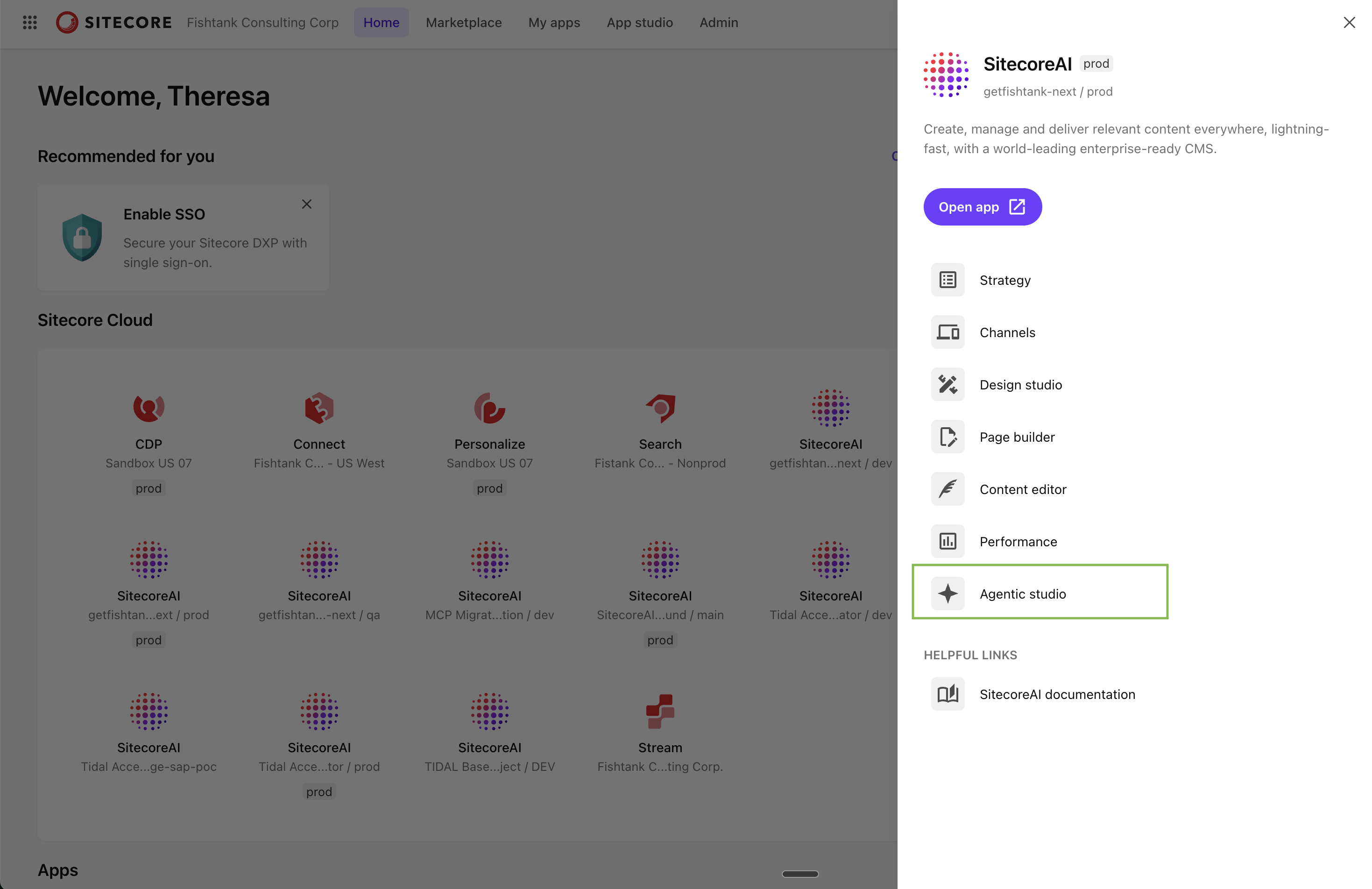
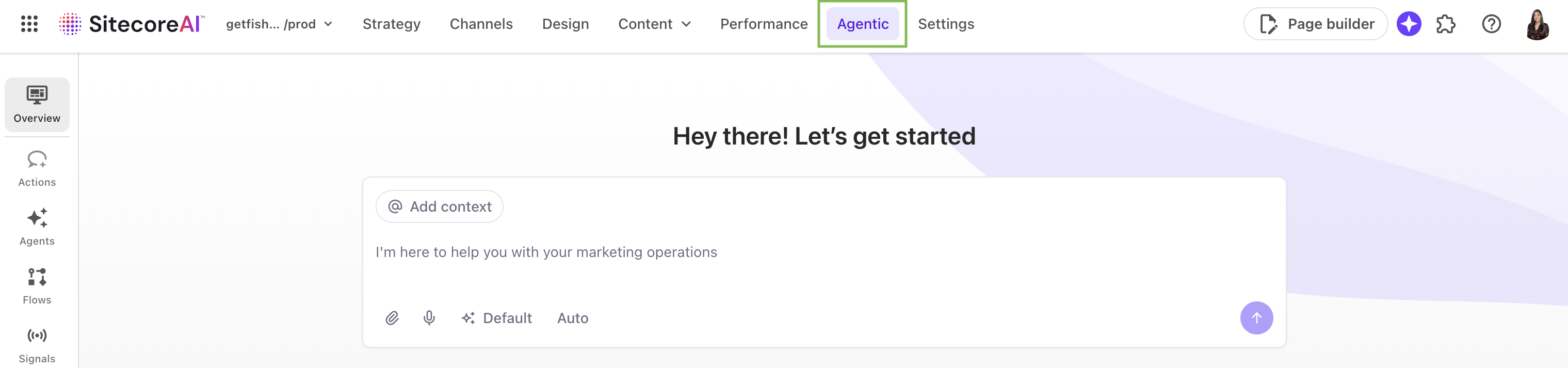
This is the dedicated workspace for initiating, managing, and monitoring long-running AI work.
Unlike traditional AI entry points that begin with only a prompt or chat window, Agentic Studio starts with agents. Agents are purpose-built capabilities designed to complete specific types of work end to end. This design choice is intentional. It makes AI work explicit, structured, and easier to govern as usage scales across teams.
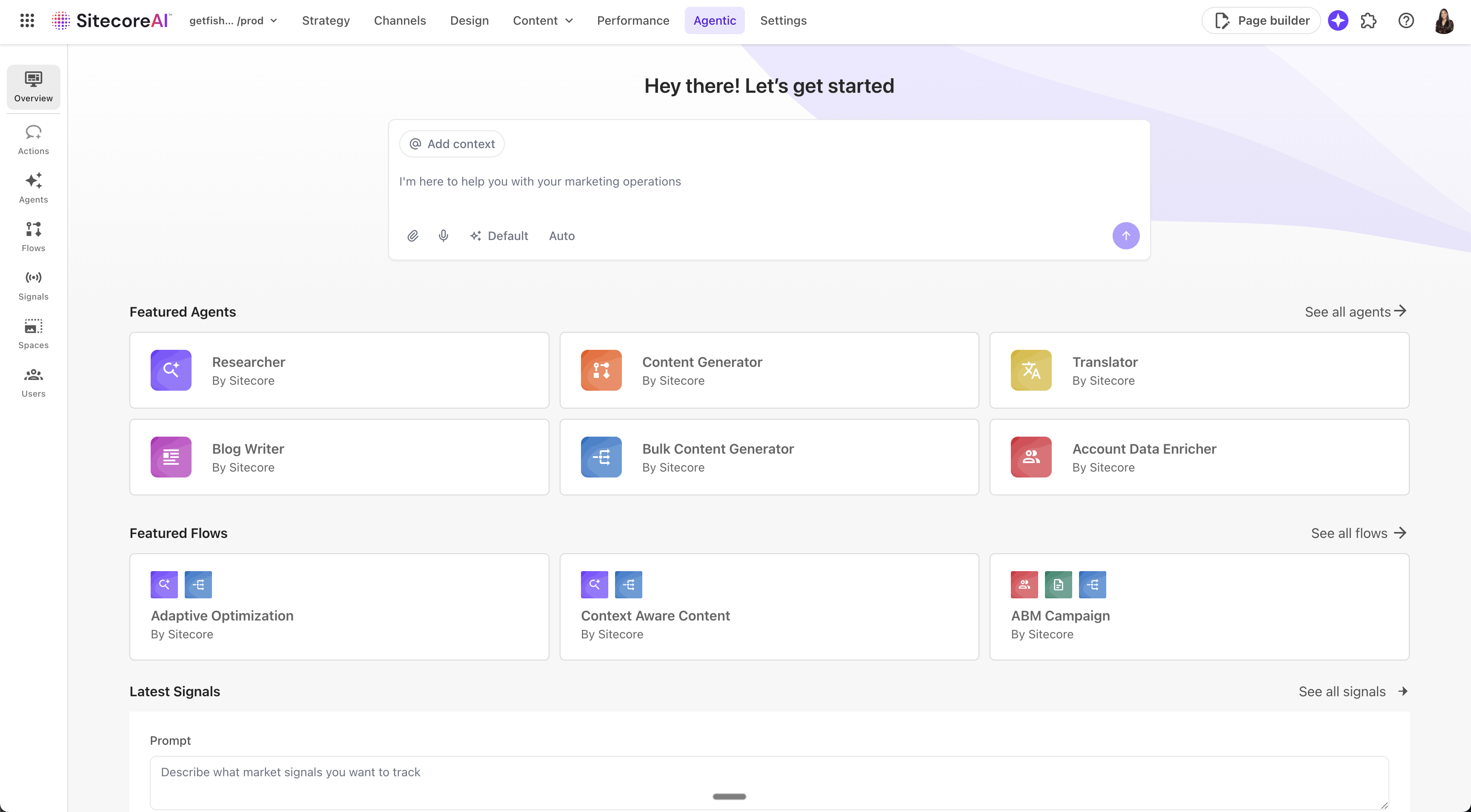
The Overview screen is the operational starting point for Agentic Studio inside SitecoreAI, designed to help teams orient, act, and monitor work quickly. From a single view, teams can initiate agentic work with context, access commonly used agents and prebuilt multi-step flows, and see early signals that indicate what is running or complete.
Agentic Studio is built around four core capabilities that define how agentic work is designed, executed, and managed in production: Agents, Flows, Signals, and Spaces. These are not surface-level features. They are the structural primitives that determine how AI-driven work operates over time.
Together, they turn AI from something teams experiment with into something they can run, observe, and scale with confidence.
Agents are task-specific AI workers designed to perform real, repeatable jobs. They are created with a defined purpose, operate with access to Sitecore content and data, and can take action through the platform rather than just generate suggestions.
Instead of relying on one-off prompts, teams define agents once and reuse them across projects. This makes AI work more consistent, more scalable, and easier to govern.
Below is a full screenshot of the out-of-the-box agents available in Agentic Studio. This is the starting point for most teams and provides a clear picture of the work SitecoreAI can support today. Out of the box, Agentic Studio includes a growing set of agents that cover common research, content, strategy, and data workflows.
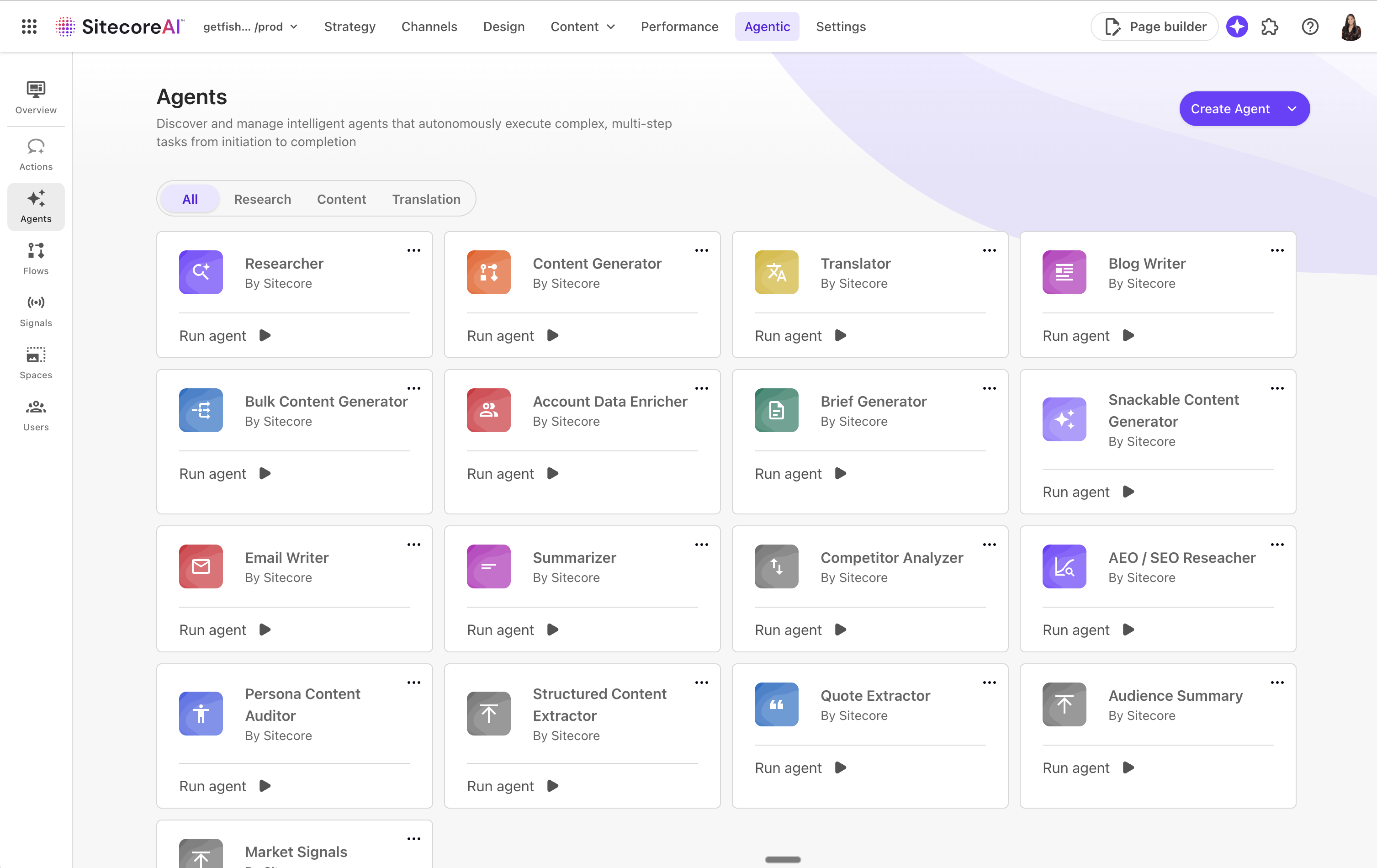
These agents are not meant to operate in isolation. Their real value emerges when they are combined into workflows that mirror how work actually happens: research feeding briefs, briefs driving content creation, content being localized and audited, and signals feeding back into planning. This is where Agentic Studio moves beyond AI assistance and becomes an execution layer for real operational work inside SitecoreAI.
Flows orchestrate how work happens inside Agentic Studio. They connect multiple agents together, introduce sequencing and logic, and allow for human review at defined checkpoints. Flows are purpose-built for multi-step work that cannot be completed reliably in a single interaction—things like campaign execution, optimization cycles, or coordinated content operations.
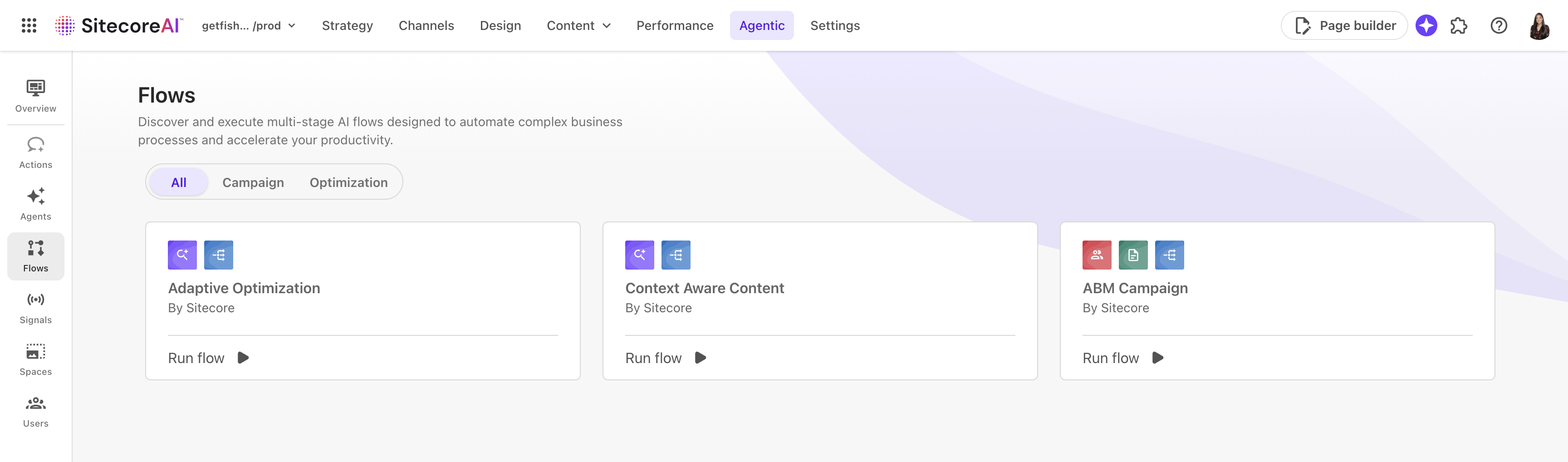
The Flows screen surfaces these workflows as first-class assets. Teams can see which flows are available, what types of outcomes they support, and run them directly without assembling steps from scratch. This is where Agentic Studio clearly moves beyond experimentation. By packaging orchestration, logic, and agent coordination into reusable flows, SitecoreAI enables automation at scale while preserving oversight, quality control, and operational consistency.
Spaces provide the operational backbone for agentic work. They act as shared work areas where agents and flows are executed, tracked, and reviewed over time, organized by initiative rather than by one-off tasks. Instead of AI outputs living in disconnected chats or exports, Spaces give teams a persistent place to see what has run, what is still active, and what results were produced.
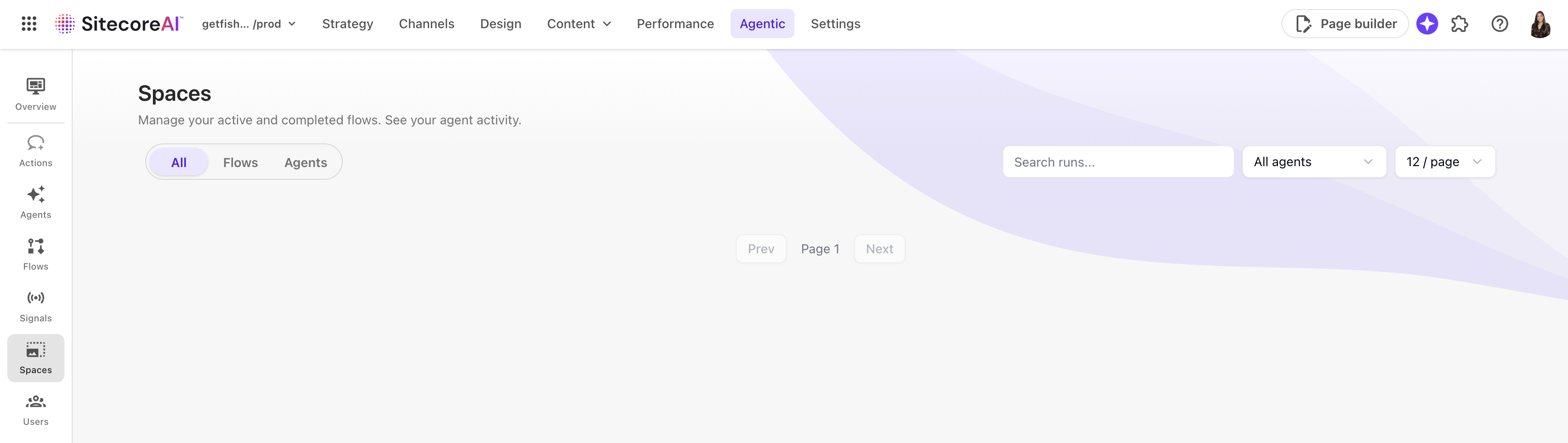
From a practical standpoint, Spaces function as the system of record for agentic execution. Teams can filter by agents or flows, search past runs, and review outputs in context. Agentic work is meant to be long-running, auditable, and collaborative. Spaces make that possible by turning AI activity into something that looks and behaves like real operational work, not background automation.
For business leaders, this is critical. Spaces ensure AI execution is visible, governed, and improvable over time. Work can be reviewed, shared, and iterated on just like any other business process, which is what allows organizations to scale agentic workflows with confidence instead of treating AI as an isolated experiment.
Signals make agentic work observable and controllable over time. They track execution status, progress, and outcomes across agents and flows, giving teams visibility into what is running, what has completed, and where attention may be required.
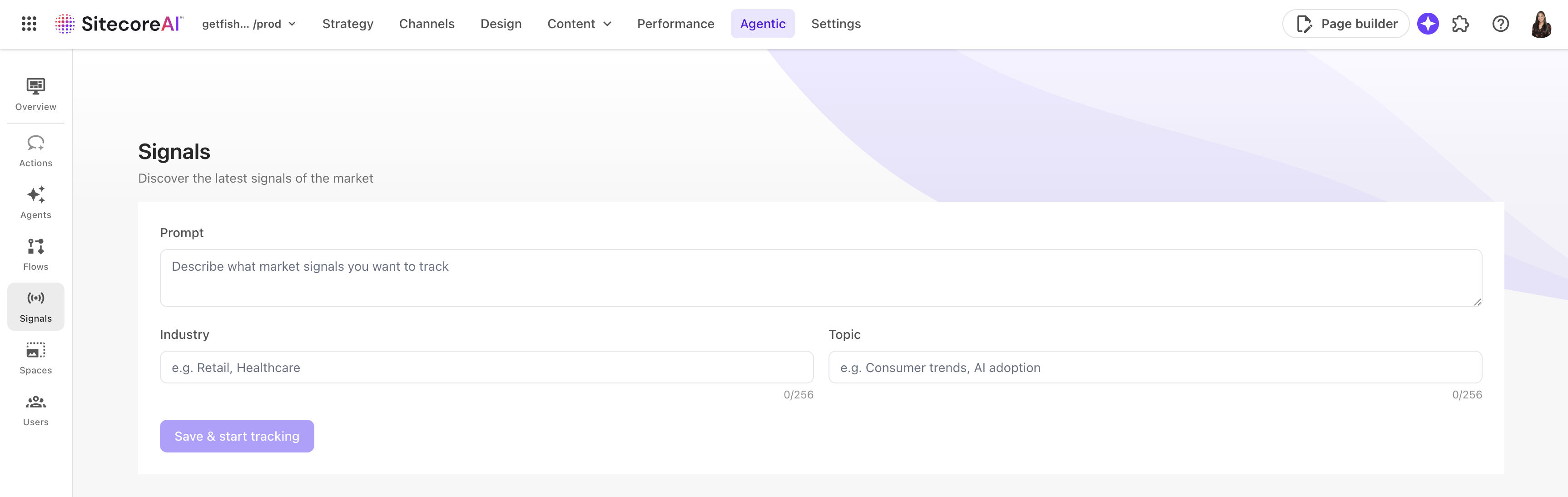
The Signals screen shows how this works in practice. Teams define the market, operational, or strategic signals they want to monitor—such as industry trends, topic shifts, or emerging behaviors—and Agentic Studio continuously tracks and surfaces updates tied to those inputs. Signals turn AI execution from a black box into a monitored system, where activity, relevance, and outcomes can be reviewed and acted on as conditions change.
Without signals, AI workflows quickly become opaque and difficult to trust. With them, organizations gain confidence that agent-driven work is not only running, but staying aligned to real-world context and delivering measurable value. This is a critical piece of what allows Agentic Studio to operate as a production-grade system rather than a set of disconnected AI tasks.
In addition to its core capabilities, Agentic Studio includes supporting navigation elements that enable execution, access, and governance but do not define how work itself is structured.
In SitecoreAI Agentic Studio, Actions are the execution layer that allows agents to do real, production work. They are the callable operations agents use to read and write data, trigger workflows, and interact with Sitecore products and connected systems. Actions make it possible for agents to move beyond recommendations and take concrete steps, such as creating or publishing content in XM Cloud, pulling analytics data, triggering personalization, updating assets in Content Hub, or calling external APIs.
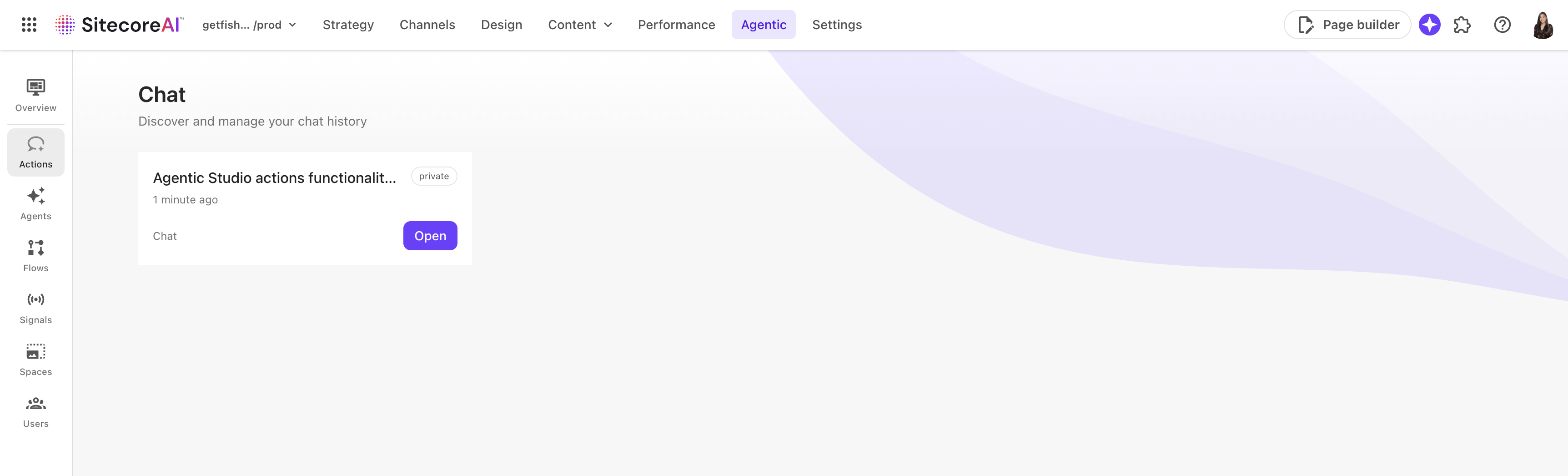
Actions are explicitly defined and governed. Each one includes structured inputs and outputs, authentication, permissions, and optional approval steps for sensitive operations. Agents select and chain actions dynamically based on context, while role-based access, audit logs, and guardrails ensure execution remains controlled and traceable. Most teams will never work directly at the action level, but this foundation is what makes agentic workflows reliable, extensible, and safe to scale across the organization.
The Users area is where Agentic Studio becomes enterprise-ready. This is where organizations define who can build agents and flows, who can run them, and who can manage or oversee execution. Roles and builder licenses make the distinction explicit between experimentation and production, ensuring that agent creation and modification are limited to the right people.
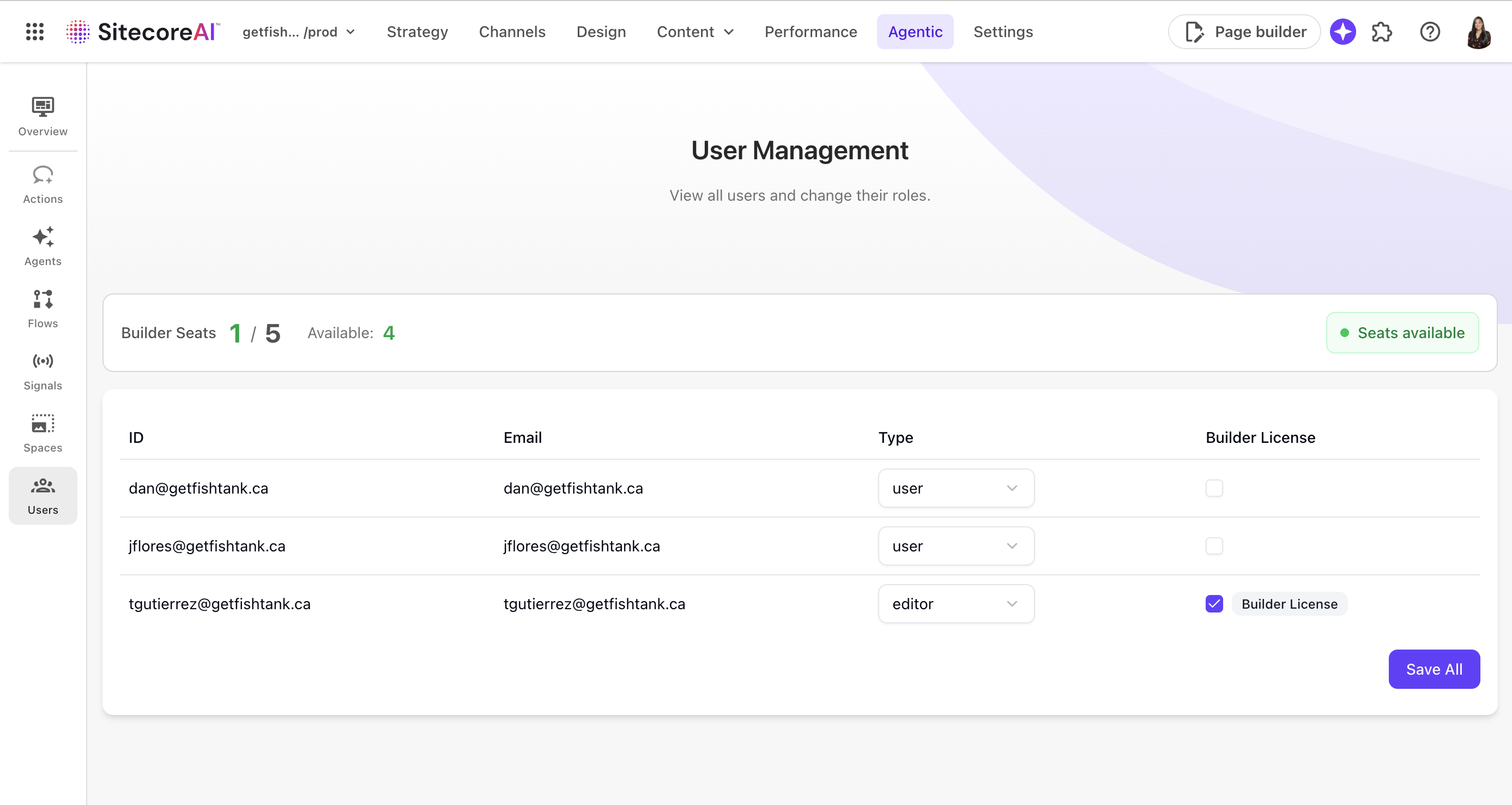
From a governance perspective, this layer is critical. Agentic systems only scale when ownership and accountability are clear. User management ties agentic work back to real teams, real permissions, and real operational responsibility. It reinforces a core principle of Agentic Studio: AI is not operating independently, it is operating on behalf of the organization, within defined controls.
Agentic Studio is designed to address real operational problems organizations face when trying to scale content, campaigns, and experiences with AI. These are not theoretical use cases. They map directly to the friction points that slow teams down, increase risk, or prevent AI from being trusted in production environments.
Creating content at scale is one of the biggest bottlenecks for digital teams, especially in multi-site or multi-region organizations. Agentic Studio allows teams to generate large volumes of pages and content in parallel, while still respecting Sitecore templates, components, and structure. The value is not just speed. It is consistency. Teams can scale output without fragmenting design systems or introducing content debt.
Global organizations often struggle to balance speed and control when localizing content. Manual translation workflows slow launches, while fully automated translation introduces risk. Agentic Studio bridges that gap. Agents can generate localized content quickly, and flows introduce review and approval steps before anything is published. This allows teams to move faster without losing confidence in quality or compliance.
Content audits are critical for modernization, but they are also expensive and time-consuming. Agentic Studio enables organizations to analyze large volumes of existing content, identify issues such as outdated messaging, structural inconsistencies, or accessibility gaps, and generate recommendations or updates at scale. This turns what is usually a one-time cleanup effort into a repeatable, ongoing process.
Many organizations struggle to connect strategy to execution. Campaign briefs are created, but translating them into live digital experiences involves too many handoffs. Agentic Studio helps close that gap. Agents can turn briefs into draft content, assemble pages, and prepare assets, while humans step in at defined points to review and approve. The result is faster time to market with clearer alignment between intent and execution.
Personalization often fails because it is disconnected from real data or too complex to maintain. Agentic Studio operates on top of SitecoreAI's unified data layer, which means agents can work directly with audience profiles, events, and signals. This allows personalization to be configured and executed consistently, based on real behavior rather than assumptions, and maintained over time without excessive manual effort.
Not all value from Agentic Studio is customer-facing. Internal teams benefit from agents that support research, summarize content, assist with operations, or enable faster onboarding and training. These use cases reduce cognitive load, free up time for higher-value work, and help organizations see immediate return on their AI investments.
Across all of these scenarios, the underlying value is the same. Agentic Studio enables scale with control. It allows organizations to automate meaningful work while preserving governance, visibility, and accountability. For teams looking to modernize with AI, this is the difference between experimentation and operational impact.
One of the clearest signals from Agentic Studio's design is that it assumes AI will be used in real production environments, not isolated experiments. The platform is built with the expectation that AI-led work needs the same controls, visibility, and accountability as any other enterprise system.
Agentic Studio is designed to keep people involved where judgment matters. Workflows can pause for review, approval, or refinement before progressing. This allows organizations to automate execution without removing human responsibility. Instead of trusting AI blindly or slowing everything down with manual processes, teams can decide exactly where human oversight is required.
Long-running AI work introduces new risks if it cannot be observed. Agentic Studio makes agent and flow execution visible by default. Teams can see what is running, what has completed, and where something may be stalled or needs attention. This transparency is critical for trust, especially as AI begins to operate across multiple systems and over longer periods of time.
Agentic Studio is built to operate within enterprise guardrails. Agents do not act independently of governance. They operate within defined permissions, approved skills, and platform-level controls. This ensures AI activity aligns with organizational policies, regulatory requirements, and brand standards rather than bypassing them.
The platform also acknowledges that AI systems improve over time. Agentic Studio supports adaptation and learning in a controlled way, allowing workflows to evolve while remaining observable and governed. This avoids the common enterprise fear that AI behavior will drift without accountability.
Taken together, these capabilities make an important point: Agentic Studio is not positioned as experimental AI. It is designed to run inside production systems, alongside existing content, data, and experience workflows, with the safeguards enterprises expect. That focus on governance and oversight is what allows organizations to move from cautious experimentation to confident adoption at scale.
Agentic Studio is positioned as a long-term execution layer within SitecoreAI, not a feature experiment. The roadmap shows a deliberate progression toward making agentic workflows central to how teams execute, govern, and extend AI-driven work across the platform.
The current focus is on making agentic work reliable and observable. Agents can be sequenced through actions, signals can trigger execution, and all outputs are treated as artifacts that can be reviewed, reused, and governed. Custom agents support public and private visibility, and the agent builder is becoming more atomic, enabling smaller, composable capabilities instead of one-off solutions.
Near-term investment centers on business context and ecosystem integration. Deeper connections through Model Context Protocols allow agents to operate across SitecoreAI, marketer data, documentation, and external systems. Permissions, shared spaces, and shared outputs introduce collaborative agentic work, moving teams away from isolated executions toward shared, repeatable workflows. Alignment with Microsoft Foundry agents reinforces an interoperable approach rather than a closed system.
Longer term, the roadmap points to richer context discovery through knowledge graphs and dynamic context generation. Spaces evolve into collaborative workspaces, and extensibility expands to include bring-your-own agents, tools, and foundation capabilities. Integration with Microsoft Copilot and other external AI systems underscores an open, API-first strategy.
If you have specific questions about the Agentic Studio roadmap, please reach out to our team.
Agentic Studio is not a toggle. It rewards intent.
Real value comes from choosing the right agentic use cases, structuring workflows around outcomes instead of tasks, embedding governance from day one, and aligning execution with SitecoreAI's broader platform strategy. When those pieces are in place, Agentic Studio stops being an interesting capability and becomes an operational system.
This is the point where SitecoreAI becomes real.
If you're still building context, our Intro to SitecoreAI article provides a clear foundation for how the platform fits together. If you're evaluating adoption more seriously, the SitecoreAI Pricing and Packaging Guide helps ground that strategy in practical considerations. Together, they frame the "why" and the "how" Agentic Studio is the "now".
For teams considering a move to SitecoreAI, planning a migration, or pressure-testing where agentic workflows belong in their roadmap, the Fishtank Consulting team works with the SitecoreAI platform every day. We help organizations translate these capabilities into operating models that hold up in production, not just demos.
For deeper technical detail, Sitecore's official documentation on Agentic Studio is also available and worth bookmarking.
Agentic Studio is not about experimenting with AI. It is about putting AI to work—with structure, accountability, and outcomes that matter.
Until next time, happy automating!
We appreciate you contacting us, and a member of our team will be in touch shortly to address your inquiry.