Reading time: 10 min read
Sitecore + Scrunch: Why AI search visibility matters
Why AI search visibility is now non-negotiable for enterprise brands
Start typing to search...
Over the last 10+ years of my career in marketing, we have focused so much of our energy into customer experience. How well can a human use this platform, navigate this website, find what they came for. Every platform decision, every tool evaluation, every "let's do a bake-off" started with that question.
Marketing teams built entire evaluation frameworks around it: usability testing, journey mapping, A/B tests on button placement and page layout, all in service of making a human's path to an answer as fast and frictionless as possible. It was a good question, and still is.
It's just no longer the only question marketing teams have to answer.
Somewhere in the last year, a pattern started showing up in my own searches, and probably yours too. The best time of year to fly Calgary to Costa Rica, and whether it's worth booking now or waiting. A 25-minute workout that mixes strength and cardio, no gym required. Picking a travel credit card that actually pays off for someone who travels a lot. Even which neighborhoods in Calgary for a single woman in her mid-30s who wants to be near restaurants and a good gym. And once I'm actually on a trip, healthy food options within one kilometer of my hotel, somewhere I can just walk to. In every one of those, I never opened a browser tab. I got a rich, direct answer and moved on. If a brand didn't show up in that answer, I never knew it existed, and I never went looking for it.
That raises an uncomfortable question for anyone running a website: what is that website actually for now? And more specifically, who is it for? Humans are visiting less, and they're visiting less every month. Cloudflare CEO Matthew Prince confirmed just how far that shift has gone: on June 3, 2026, he announced that bot and AI agent traffic had overtaken human traffic for the first time in the internet's history, landing at roughly 57.4% bots to 42.6% humans on Cloudflare's public Radar dashboard. Something else is standing in for your human visitors now, and it already outnumbers them.
Here's the part that should get your attention: this conversation about AI has reached the boardroom. Matt Thompson, Scrunch's VP of Partnerships, put it plainly in a recent partner session: across his entire career before joining Scrunch, he was asked to bring AI content in front of a board or a chairman maybe a handful of times. In five months at Scrunch, he's fielded that same request roughly twenty times. Executives are asking pointed questions about Answer Engine Optimization (AEO), Generative Engine Optimization (GEO), and why organic search traffic looks softer every quarter.
A quick primer, since these terms get thrown around a lot:
Answer Engine Optimization (AEO): optimizing content so AI answer engines can find, understand, and cite it in their responses.
Generative Engine Optimization (GEO): optimizing a brand's overall presence and positioning across generative AI platforms.
The metrics attached to those terms are new too, and worth knowing by name: brand presence (how often you show up in AI answers), share of voice (how you stack up against competitors across those answers), citation rate (how often your domain gets cited as a source), and AI referral rate (how much human traffic actually arrives from AI platforms). Those four are quickly becoming the KPIs that matter, alongside the rankings and click-through rates marketing teams have tracked for a decade.
Those are real questions with hard answers, especially if you're working with the same tools that got you here. Enterprises need a way to see exactly how AI is representing them today, understand why, and fix it fast enough to matter. Right now, most don't have one.
Here's the part marketers should actually be excited about. For decades, we've built entire practices around inferring intent: stitching together clickstream data, third-party cookies, and customer data platforms just to guess what someone might want. AI queries flip that model. Nobody types "running shoes" into ChatGPT. They describe exactly what they need, in their own words: a shoe with high ankle support, in a size 11, for a muddy trail run in New Hampshire next weekend. That's not a keyword. That's a customer handing you their intent directly, unprompted, in more detail than any behavioral model ever gave you. For the first time, marketers get to meet that intent head on instead of reverse engineering it. The catch is that opportunity only exists if a brand actually shows up in the answer.
The old scorecard still matters: intuitive UI, a fast learning curve, drag-and-drop ease for authors. Nobody's throwing that out. But it was built to answer a question enterprises are no longer asking on its own, and a new set of tools is stepping in to answer the question that replaced it.
That's the gap Sitecore saw too. On June 3, 2026, Sitecore announced its acquisition of Scrunch, an AI visibility platform built specifically to answer this new question. It's worth understanding exactly what that platform does, because it's likely already part of your roadmap whether you've had the conversation yet or not.
Read the press release here: Sitecore Acquires Scrunch to Help Brands Influence Discovery and Buying Decisions
Scrunch is an AI Customer Experience Platform, founded in 2023 and already used by 500+ brands and agencies, including Lenovo, Skims, Crunchbase, and Penn State. It's built around three connected capabilities that work together: see where you stand, understand why, and fix it directly.
| Capability | What it does | Key features | Outcome |
|---|---|---|---|
| Monitoring | Tracks exactly how your brand shows up across AI platforms | Prompt-level tracking of brand presence and placement ("share of answer"); competitive benchmarking by topic, persona, and geography; real-time feed of AI bot traffic (GPTBot, ClaudeBot, PerplexityBot) crawling your site | Full visibility into where you appear, where you're missing, and how you compare to competitors across ChatGPT, Gemini, Claude, and Perplexity |
| Insights | Explains why you're winning or losing visibility | Citation analysis showing which sources AI models trust and pull from; error detection for technical issues blocking AI crawlers; prioritized content recommendations to close specific gaps | A clear, ranked list of what to fix and why it matters, instead of a raw data dump |
| AXP (Agent Experience Platform) | Delivers a version of your content built for AI agents to read | Generates a parallel, machine-readable version of your pages, served only to AI retrieval bots at the CDN layer; strips code bloat and JavaScript dependencies; restructures pages into clean headings, FAQs, and specs LLMs prefer to cite | Faster, more accurate parsing and citation by AI models, with zero change to the human-facing site, design, or traditional SEO |
The three pieces are designed to function as a loop rather than standalone tools, not four separate tools bolted together.
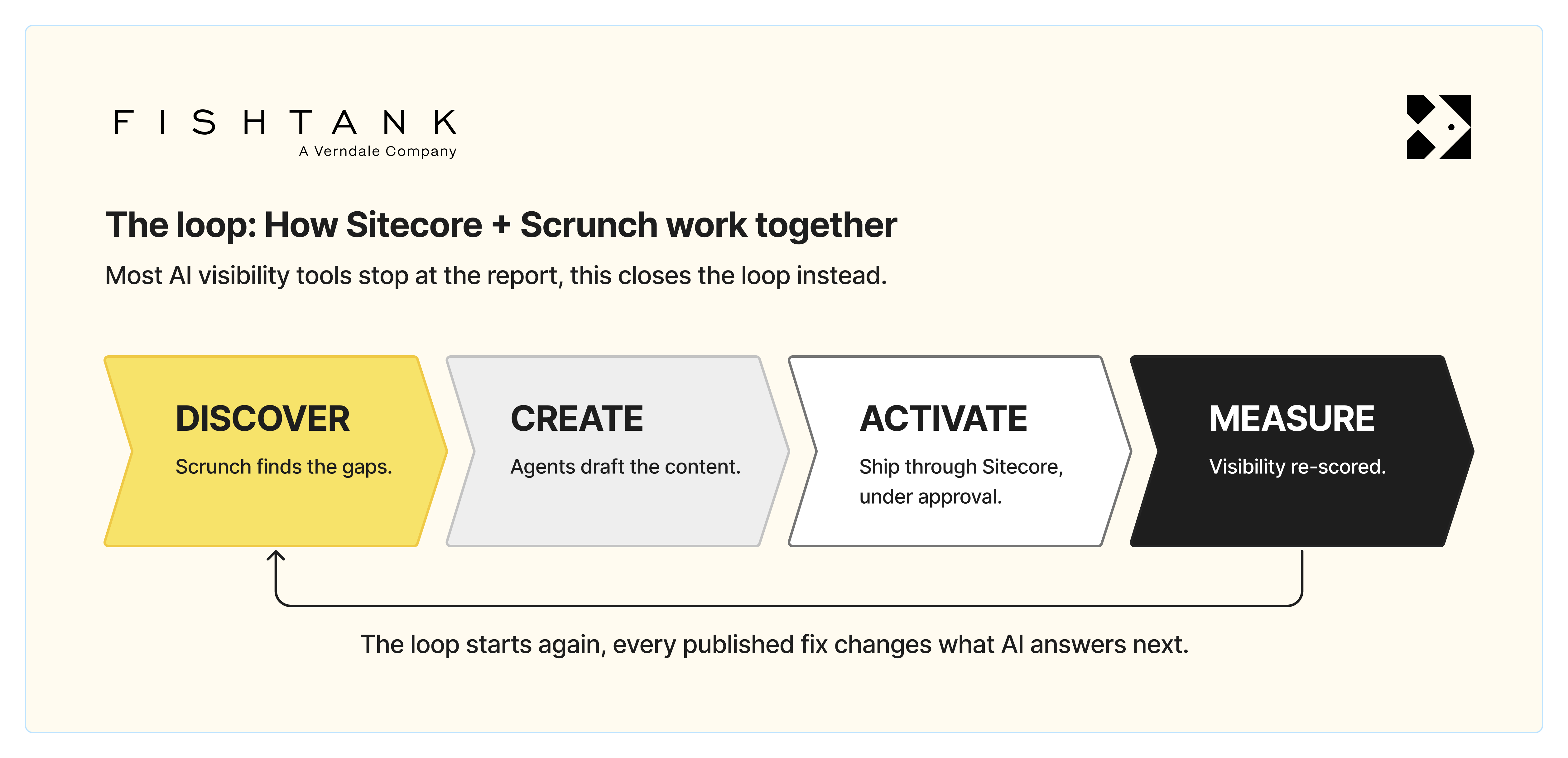
Monitoring shows you the problem, Insights explains the cause, and AXP fixes the delivery, all without requiring a rebuild of the site itself. Scrunch cites one example of AXP shrinking a pricing page from roughly 124,000 tokens down to about 1,255 for AI consumption, with none of that reduction visible to a human visitor.
They're essentially "scrunching" your website down to exactly what an AI agent needs, hence their name.
AXP itself works two ways. Universal Optimization strips out everything AI agents can't read, images, JavaScript, rich media, and serves clean, structured HTML without changing any of the underlying content. That matters if you're in a regulated industry with a long approval process behind every piece of copy: nothing about the words themselves changes, only the format they're delivered in. Adaptive Optimization goes a step further. It identifies content gaps, the questions AI bots are trying to answer on your site that you haven't actually answered yet, and fills them using content that already exists elsewhere in your organization, in a DAM, an intranet, or SharePoint, or by creating net-new content where nothing exists at all.
That gap-filling runs through what Scrunch calls its Knowledge Studio, which connects directly into a company's CMS and DAM to surface the content that closes those gaps, then pushes it either into human-facing pages through the CMS or straight into AI-facing Scrunch pages deployed at the CDN. For Sitecore customers specifically, that means Scrunch isn't just reading what's on your website. It's reaching back into the DAM and CMS you already run, and putting content you've already created, but maybe never published to the site, to work in front of AI agents.
The delivery is the problem you haven't solved. Most enterprises running Sitecore have deep, well-governed content estates. The real issue is that AI agents often can't parse or trust what's already there. Scrunch's Insights layer identifies exactly which pages and facts are causing that failure, and AXP fixes the delivery without requiring a rebuild.
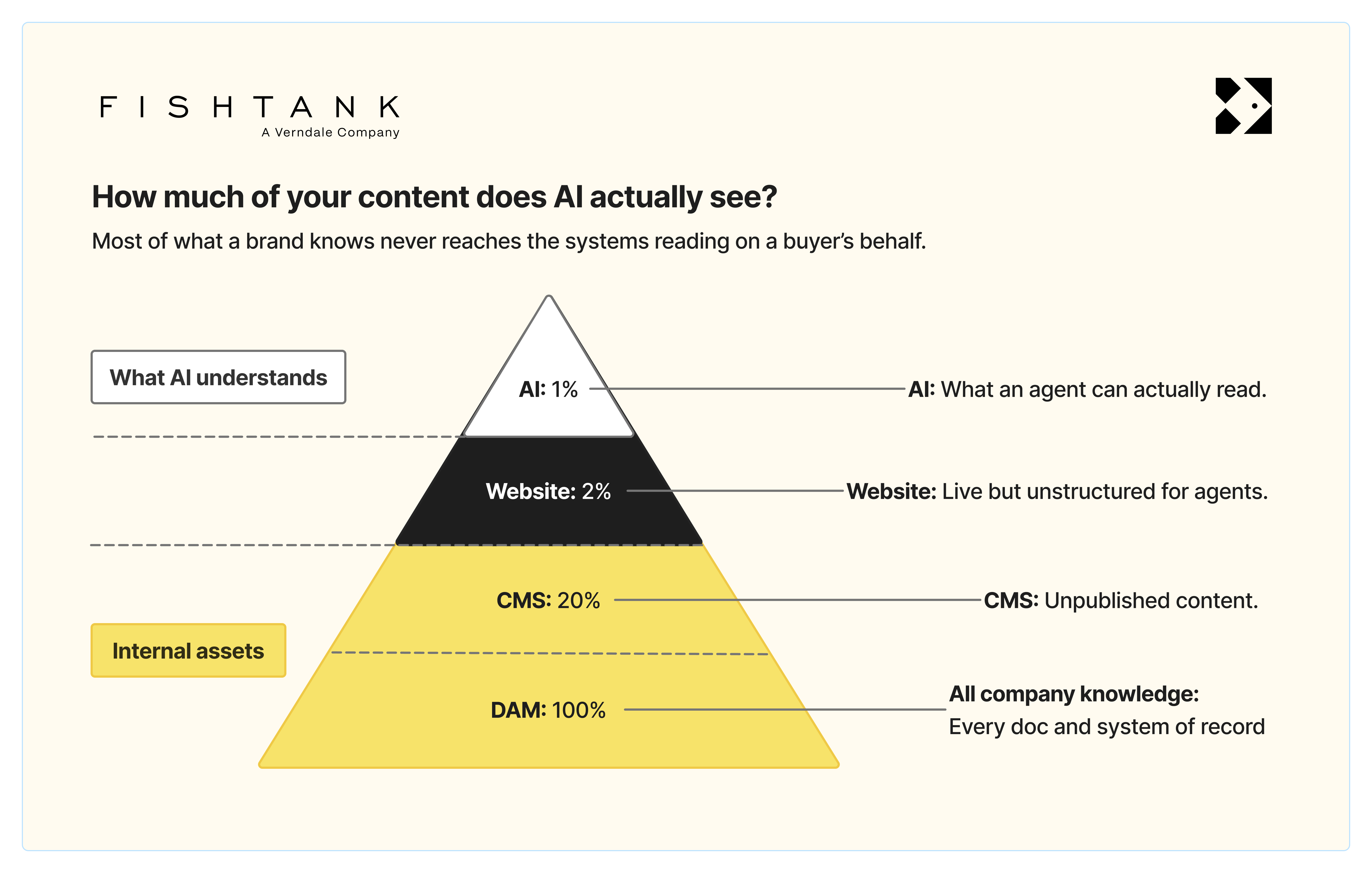
Brand consistency, approved messaging, accurate pricing, all the reasons you use a CMS in the first place, mean nothing if an AI model is citing an outdated page, a competitor's page, or simply guessing. Scrunch closes that loop by connecting directly into SitecoreAI's content management, content marketing, and DAM workflows, turning recommendations into published fixes instead of a report nobody actions.
An upcoming Scrunch release adds Site Diagnostics, which runs page by page across a site and ships three types of updates directly to a team:
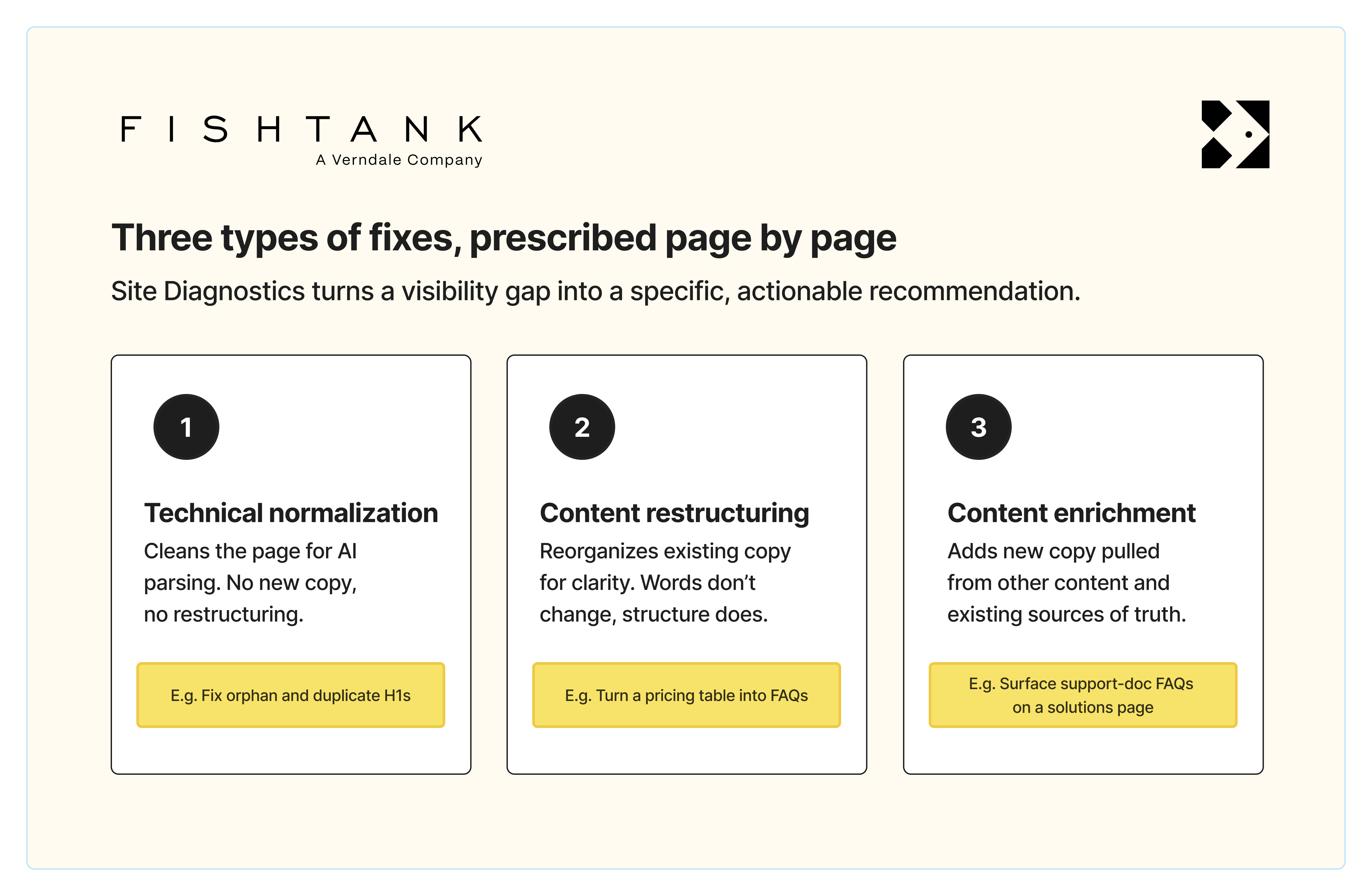
Each recommendation is specific enough to become a ticket or a scope of work on its own, turning insight into an action list a team can actually execute against.
Scrunch cites Forrester research showing up to 90% of B2B buyers now use generative AI during purchasing, with G2 data indicating power users spend markedly less time in the evaluation stage than they used to. The shortlist is forming earlier and faster, often before a brand's own site is ever visited. Scrunch also reports that visitors referred from AI platforms convert 3 to 5 times higher than traditional organic search traffic. Buyers who arrive via AI are further along and worth more, which makes losing visibility at that stage a high-value miss.
In a joint study with Akamai, AXP-enabled pages saw a 364% increase in brand presence for non-branded prompts and a 218% increase in citations in AI-generated results, compared with otherwise-comparable pages without AXP. Runpod reported a 400% increase in paying customers tied to its AI search optimization work, and Clerk reported a 9x increase in AI-driven sign-ups after adopting the platform.
AXP serves its AI-optimized version only to real-time AI retrieval bots, while Google and Bing's indexing crawlers see your site exactly as before. This complements what Sitecore customers already do well, filling in the layer next to it.
The Cloudflare number mentioned earlier is worth sitting with. Bots and AI agents don't just occasionally visit a website anymore. As of June 2026, they make up the majority of traffic hitting it. That split isn't reversing.
Even Google has started saying the quiet part out loud. At Google I/O and Google Marketing Live this past May, Google told marketers their web properties need to be "agent ready," a notable admission from the company that built its entire business on the ten blue links. Google's own numbers back up the urgency: 68% of searches now end without a click, and that number climbs to 83% when an AI Overview appears. When the company with the most to lose from this shift is telling you to prepare for it, that's a reasonable moment to stop waiting.
The uncomfortable part of this shift is that it's largely invisible until you go looking for it. A brand can be losing ground in AI-generated answers, misrepresented, uncited, or absent entirely, for months without a single metric in a traditional analytics dashboard reflecting it. There's no bounce rate for a conversation that never reached your site.
For Sitecore customers, the practical starting point is straightforward: monitor first, so you know exactly where you stand across ChatGPT, Gemini, Claude, and Perplexity, then act, using AXP and Scrunch's recommendations flowing directly into the content workflows you already run in Sitecore. The content you need probably already exists. The job now is making sure the systems reading it on your buyer's behalf can actually find it, trust it, and get it right.
Reading about this shift is one thing. Knowing exactly where your brand stands in it is another. If you're running your digital experience on Sitecore and haven't yet checked how AI platforms are actually representing you, that's the first conversation worth having, before it becomes a board-level question you don't have an answer to.
Fishtank works with Sitecore customers on exactly this: understanding where you stand today, and building the plan to close the gap. Reach out to our team, and let's figure out what your AI visibility actually looks like right now.
Until then, happy optimizing!