Reading time: 5 min read
Sitecore acquires Scrunch: What this means for Sitecore users
Sitecore’s Scrunch acquisition helps make your DXP visible to AI
Start typing to search...
You likely have already heard the news, Sitecore has acquired Scrunch. But you may not have heard of Scrunch, or be aware of what it has to offer, or how it can help your company standout.
If you work in the Sitecore ecosystem, the real value is not just that Sitecore bought another AI company. The value to you is that Scrunch helps solve a problem that most content and marketing teams are only starting to understand properly: your website now has two audiences.
Humans are still one of them, but AI agents are the new one. And they’re increasingly becoming the larger audience.
Scrunch positions itself as an AI customer experience platform, with a strong focus on helping brands show up in AI-generated answers, recommendation flows, and citation paths.
In plain English, Scrunch is built around a fairly practical idea:
And as I’m sure many organizations are starting to realize, this really matters.
Traditional SEO was built around ranking in a list of links. Scrunch is aimed at a different layer of discovery: getting cited, referenced, understood, and surfaced inside AI-driven answer experiences.
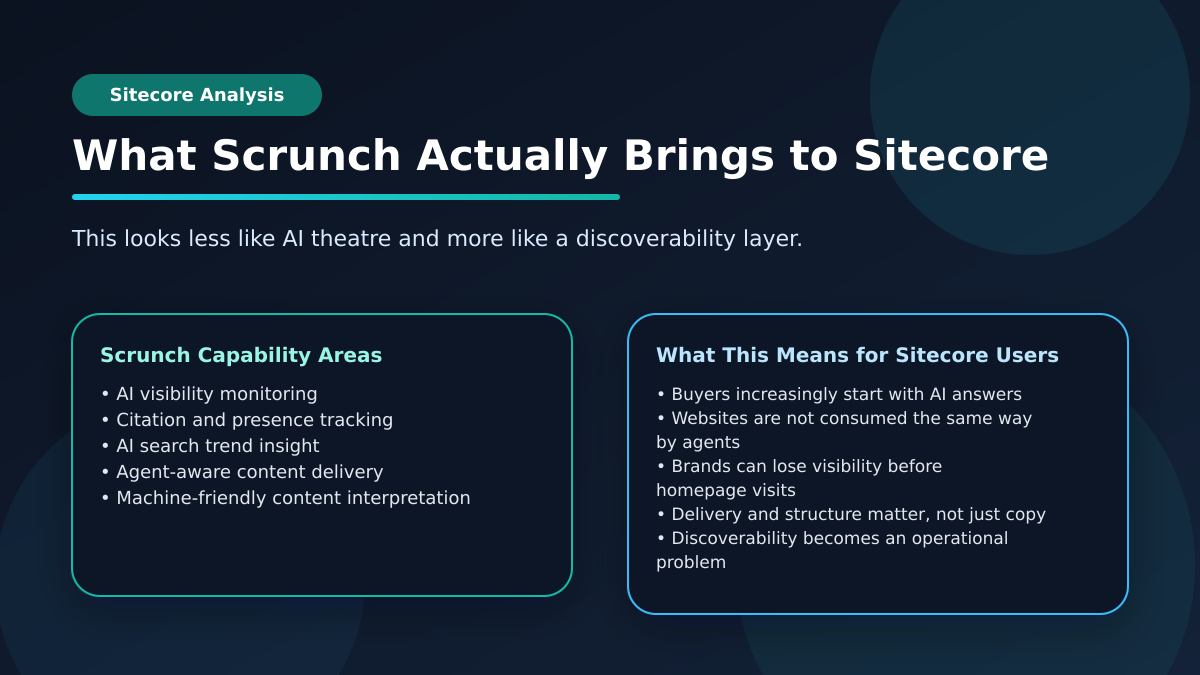
Based on Scrunch’s current positioning, the platform seems to center on a few core capabilities:
And that last point is an important one, as we still want to maintain the experience for human visitors.
A lot of companies still think of optimization as a content exercise only. Scrunch looks more infrastructural than that. It suggests that AI discoverability is also a delivery, rendering, and content-shaping problem.
Sitecore already has most of the pieces needed to manage content and orchestrate customer experiences.
What it has not had though, at least not in a clearly productized way, is a strong answer to this question:
How do Sitecore customers stay discoverable when AI assistants increasingly sit between brands and buyers?
This is where Scrunch fits into the equation.
If Sitecore integrates it properly, Scrunch could extend Sitecore from being a platform that manages digital experiences to one that also helps shape how those experiences are interpreted by AI systems.
Instead of stopping at content creation, personalization, analytics and search on owned properties, Sitecore could start addressing upstream discovery inside AI ecosystems.
The interesting part is not the acquisition headline, it’s the overall product fit. Here’s where Scrunch could add real value for Sitecore customers.
Sitecore users already invest heavily in structured content, reusable components, taxonomy and governance. That work becomes even more valuable if it can be measured against AI visibility outcomes rather than just page traffic keyword rankings.
Scrunch could help connect those dots, instead of asking only:
Teams may also be able to ask:
This makes for a useful expansion of the measurement model.
One of Sitecore’s long standing strengths is content operations at scale. If Scrunch plugs into that properly, Sitecore customers could use the same governed content foundation not just for websites and campaigns, but for AI-facing discoverability as well.
This is important because most enterprises do not want another disconnected AI tool. They want their existing content stack to become more useful.
If Scrunch becomes part of that story, the acquisition starts to look less like bolt-on AI theatre and more like a sensible extension of existing investment.
Most teams will still have weak visibility into how AI systems describe their products, cite their pages, or ignore them entirely. Scrunch looks to be designed to surface that blind spot.
For Sitecore marketing teams, that could create a much stronger loop between:
Which is much better than simply saying “we added AI.” It’s a measurable impact, and that is what enterprise teams usually care about.
A DXP that only manages pages is increasingly too narrow. Buyers now discover products through AI summaries, assistant recommendations, generated comparisons, and answer engines that may reduce direct site visits.
If Sitecore wants to stay relevant in that environment, it needs to help customers win before the click. The Scrunch acquisition looks like a move in exactly that direction.
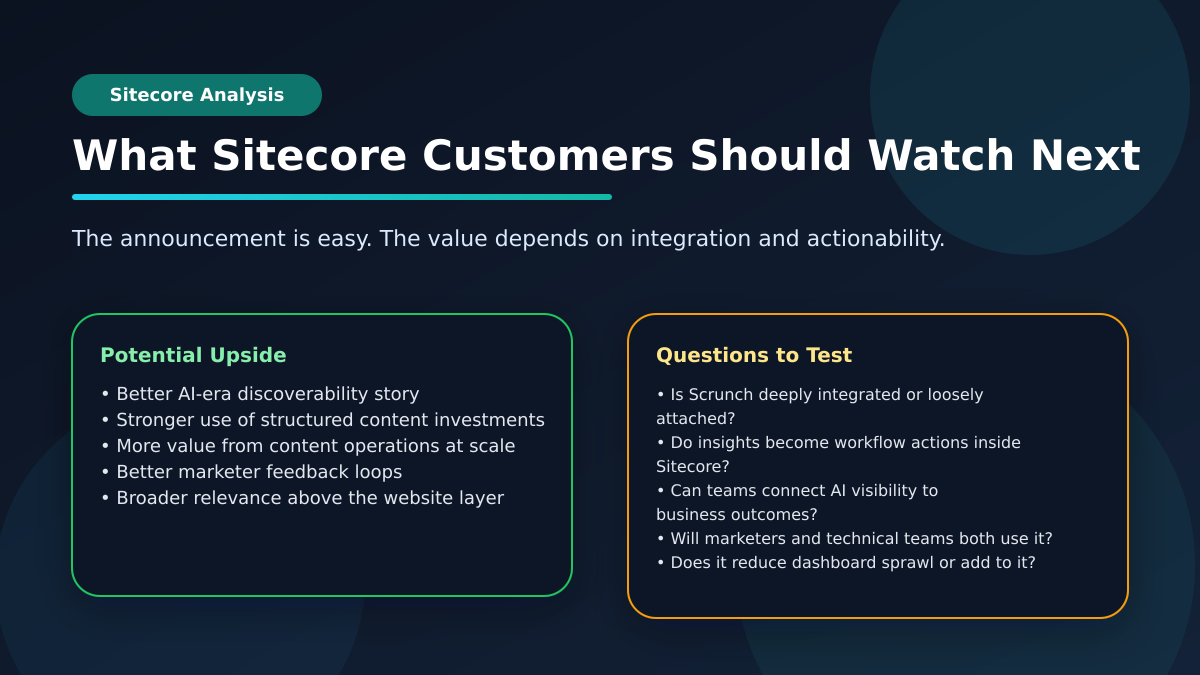
The acquisition is promising, but the practical details matter more than the announcement.
Sitecore customers should watch for a few things:
Enterprise martech stacks already have enough orphaned insight tools. If Scrunch just tells you that AI visibility is changing, that is mildly interesting at best. If it helps you act on it inside the platform you already use, that is valuable.
The web is not disappearing, but the path to it is changing at a rapid pace. That is what this acquisition is really about.
Scrunch gives Sitecore a way to talk about AI not just as content generation or copilots, but as a discovery and experience problem. To Sitecore customers, that is much more useful. Because for them the challenge isn’t “How do we add AI to a website?” but instead “How do we make sure our brand, products and content still show up when the customer journey increasingly starts somewhere else?”
If Scrunch helps Sitecore answer that clearly, then the acquisition could be genuinely smart. If it ends up as a disconnected feature story, then it will be just another press release.